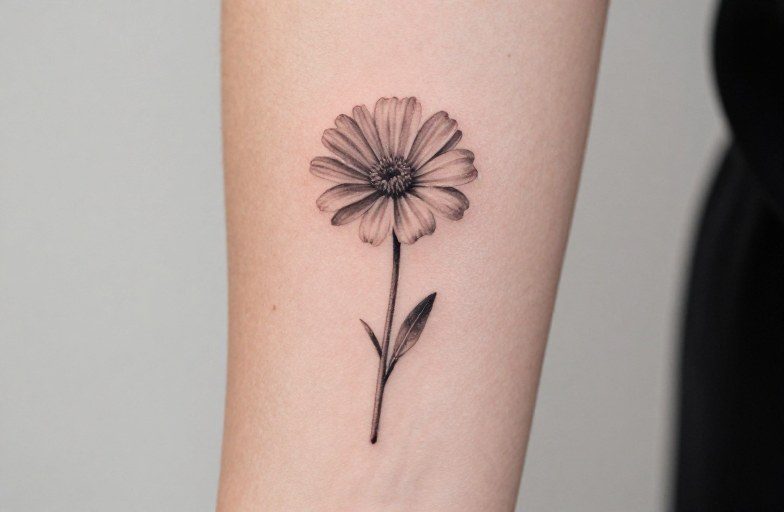
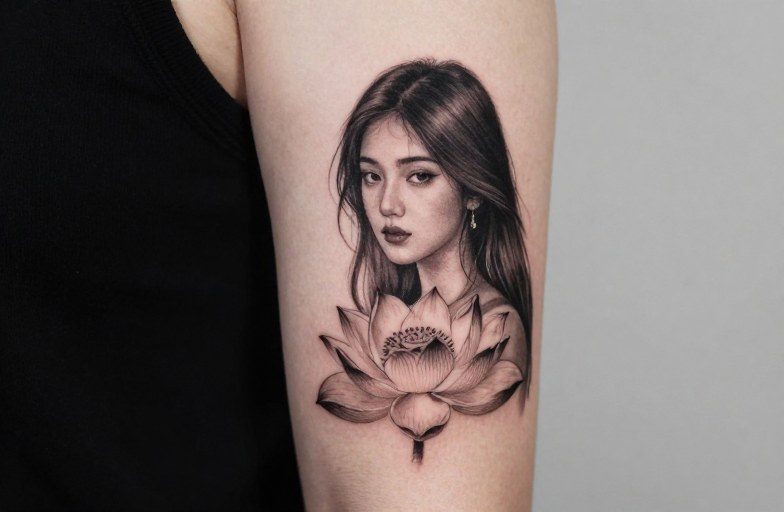
A lotus tattoo on a woman most commonly signals growth through adversity, roots in mud, stem through water, bloom above the surface. The image carries specific weight for women because the flower’s daily cycle of closing at night and reopening at dawn maps neatly onto lived experiences of renewal, endurance, and self-directed change. Unlike more aggressive symbols of strength, the lotus offers a softer visual language that doesn’t need to announce itself.
Who Chooses This Tattoo
Women drawn to lotus imagery often arrive after a pivot point, divorce, recovery, career change, coming out, surviving illness. The tattoo functions as a marker rather than a memorial. It says this happened, and I am still here in a different form.
Age and Timing
Placement and size shift noticeably by decade. Women under twenty-five tend toward small, single-needle designs on ribs or behind the ear, often their first tattoo. Women over forty frequently choose larger work, full shoulder pieces, thigh compositions, sternum-to-navel arrangements, usually after years of considering it. The lotus works across this span because its symbolism compresses well: a thumbnail outline carries the same semantic weight as a ten-inch back piece.
Cover-Up and Scar Integration
The lotus structure lends itself to covering older tattoos or incorporating surgical scars. The layered petals create natural depth that distracts from uneven skin texture underneath. Artists can build outward from a central point, letting the geometry of the flower absorb whatever lies beneath. This practical advantage drives more choices than most clients initially admit.
Personal & Modern Meanings
Beyond the generic “overcoming adversity” reading, women assign specific, sometimes idiosyncratic meanings to lotus placement and color. A white lotus on the sternum might mark a commitment to celibacy or asexuality. A pink one on the hip bone can commemorate fertility treatment or pregnancy loss. The meaning lives in the combination of image, body location, and personal narrative, not the flower alone.
Color as Code
- White: Purity in the Buddhist sense, emptiness, potential, not moral cleanliness. Popular among women leaving restrictive upbringings.
- Pink: Devotion, often to self rather than another. Common after therapy or sobriety milestones.
- Red: Heart-centered courage, not romance. Chosen by women rebuilding after betrayal or abuse.
- Black/grey: Refusal of easy redemption narratives. The mud matters as much as the bloom.
- Blue: Rare, usually referencing the medicine Buddha or personal struggles with mental health.
Contemporary Twists
Some women request lotus petals formed from other imagery, sheet music, city skylines, DNA helixes, animal silhouettes. These hybrid designs work best when the lotus structure remains legible; too much abstraction and the symbol dissolves into generic floral. A skilled artist will preserve the radial symmetry that makes the lotus instantly readable even at small scale.
Design Tips & Pairings
The lotus pairs successfully with several motifs, but the combination needs spatial logic, not just aesthetic preference. A lotus with a snake coiled through it reads as temptation and transcendence intertwined. A lotus breaking through concrete suggests urban resilience. A lotus and moon pairing emphasizes cyclical time, menstruation, mood, the body’s own tides.
Line Work vs. Shading
Single-needle outline lotuses age poorly on areas with frequent sun exposure or friction. The fine lines blur within five to seven years, becoming indistinct grey smudges. For longevity, choose bold linework (minimum 0.5mm needle groupings) with limited black fill, or commit to full color saturation where pigment density protects against fading. Watercolor-style lotus tattoos, while visually striking, require touch-ups every three to five years to maintain contrast.
Common Pairings That Work
- Unalome: The spiraling path to enlightenment, often placed above or beside the lotus. The unalome’s straight line at the top echoes the lotus stem.
- Mandala: Geometric expansion outward from the flower’s center. Best on flat areas: back, thigh, sternum.
- Koi fish: Shared upstream struggle narrative. Requires larger canvas to avoid visual crowding.
- Script: Risky. Text and image compete for attention; if used, place lettering in negative space between petals, not across them.
Religious & Spiritual Angles
The lotus carries distinct weight in several traditions, and women sometimes adopt it without full awareness of those roots. This isn’t inherently problematic, symbols migrate, but understanding the lineage prevents awkward collisions, like placing a Buddhist sacred image in a sexually provocative location without intent.
Hindu and Buddhist Contexts
In Hindu iconography, Lakshmi stands on a pink lotus; Saraswati sits on a white one. A woman choosing these colors in traditional arrangements may be read as invoking specific goddess energy, whether or not she intends this. In Buddhism, the lotus often linked to Padmasambhava (the lotus-born) and the concept of purity emerging from samsaric mud. The eight-petaled lotus specifically maps to the Noble Eightfold Path.
Respectful Adaptation
Women outside these traditions can wear lotus tattoos without appropriation if they avoid direct copying of sacred mandalas or deity-specific color protocols. A generic five-petaled lotus in non-traditional colors, green, orange, purple, signals secular appreciation rather than religious claim. When uncertain, consult with the artist about which traditional elements to omit.
Best Placements
The lotus adapts to body contours better than most floral designs because its radial symmetry works at any rotation. However, certain placements carry established connotations within tattoo culture.
- Sternum/underboob: High visibility, significant pain. The lotus here often reads as reclaiming femininity after trauma or surgery. Skin stretches with weight fluctuation; choose a design with some internal negative space to accommodate.
- Shoulder cap: Classic, unisex placement. The curve of the deltoid mirrors the cupped shape of a half-open lotus. Ages well, easy to show or conceal.
- Thigh: Large canvas allows detailed petal layering. Inner thigh hurts more but stays protected from sun; outer thigh is social but fades faster.
- Behind ear: Tiny, almost always single-needle. Fades quickly, needs refresh. Chosen for personal reminder rather than public statement.
- Foot/ankle: The lotus’s association with spiritual grounding makes this placement logical, but foot tattoos blur badly and heal poorly due to constant friction and lymphatic pooling.
- Lower back: Reclaimed from the “tramp stamp” era by women who refuse to let male derision dictate their choices. The lotus’s vertical stem suits the spine’s channel.
How It Ages on Skin
All tattoos degrade, but lotus designs have specific vulnerabilities. The fine lines between petals, essential for the layered look, are the first to blur. On sun-exposed skin, a detailed lotus becomes a pink or grey blob within a decade without protection.
Technical Preservation
Black ink outlasts color; if longevity matters, build the lotus from black line with selective color accent rather than full petal saturation. White ink (used for highlights) disappears almost entirely on most skin tones within two years, plan for its absence, not its presence. Yellow and light pink fade fastest; deep red and blue hold better but still require sunscreen.
Skin Changes
Pregnancy, weight gain, and aging alter every tattoo, but the lotus’s central symmetry helps. A stretched lotus still reads as a lotus; an asymmetrical design would distort into unrecognizability. Women planning children should avoid sternum and lower abdomen placements if they want the design to survive intact. Post-mastectomy lotus reconstructions are increasingly common, with artists rebuilding the flower across scar tissue to restore a sense of wholeness.
What to Remember
The lotus tattoo on a woman carries genuine symbolic density, but its power depends on specificity. A stock image from Pinterest, placed without thought to body location or personal context, becomes decorative noise. The women who carry this image most meaningfully have usually made deliberate choices: color that encodes private significance, placement that respects how their particular skin ages, scale that fits their pain tolerance and maintenance commitment.
Work with an artist who understands the difference between a pretty flower and a symbol that needs to hold weight for decades. Ask to see healed photos, not just fresh work. Consider how the design will look in a swimsuit, in a casket, in a nursing home. The lotus has been blooming in human consciousness for millennia; your version should be able to last at least your lifetime.
Frequently Asked Questions
Does a lotus tattoo always mean the person is Buddhist or Hindu?
No. The lotus has become a broadly secular symbol of resilience and personal growth. Only specific traditional color arrangements or deity pairings signal religious affiliation.
How much does a lotus tattoo typically cost?
Small simple designs run $150-$300; detailed multi-color pieces on larger areas range $500-$1,500. Sternum and rib placements often cost more due to difficulty and time.
Can a lotus tattoo be easily covered up later?
The radial symmetry and dense petal structure actually make lotus tattoos challenging to cover. The central negative space and light colors limit what can go over them. Plan for the long term.
Is the lotus tattoo overdone or too common?
Common symbols become common because they work. The difference between generic and meaningful lies in custom design, thoughtful placement, and personal context, not in avoiding the image itself.