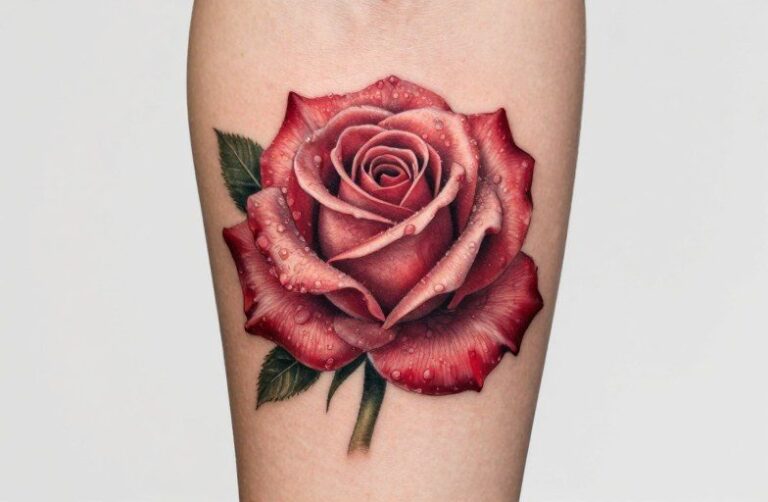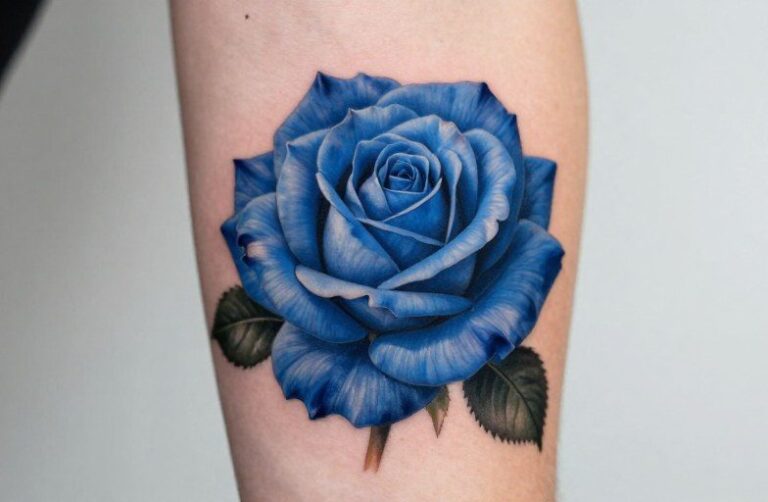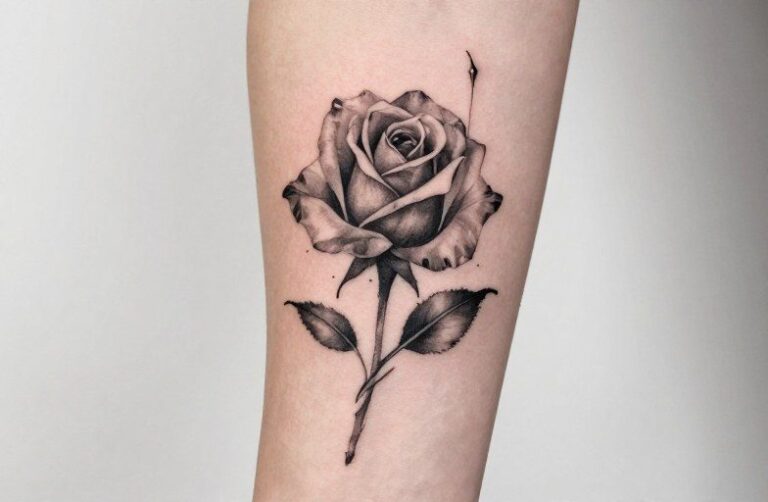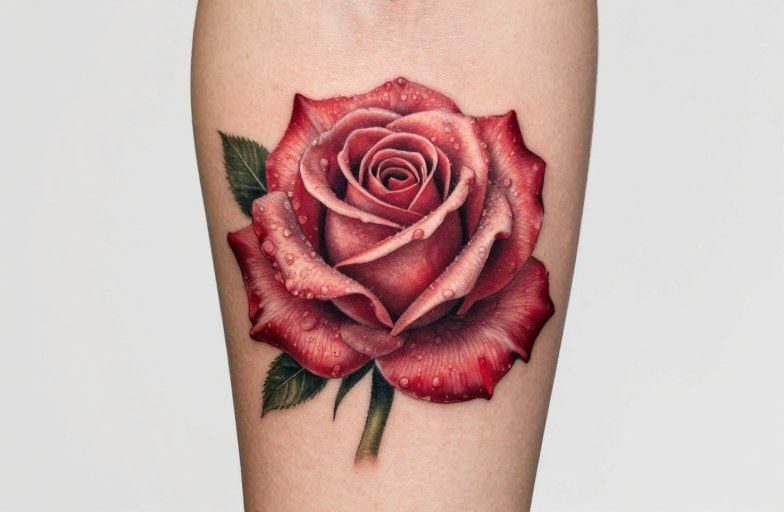
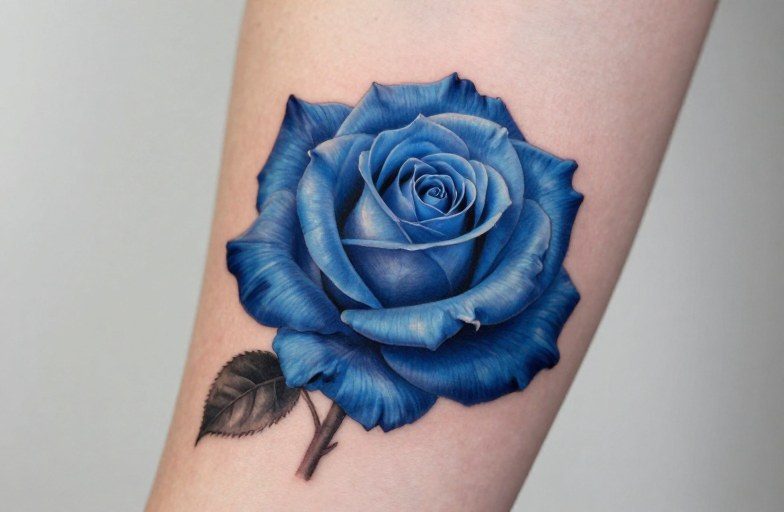
A realistic blue rose tattoo attempts what nature never produced: a rose in true blue. The flower doesn’t exist genetically, so the tattoo lives entirely in constructed realism. Artists must convince the eye through color theory, shadow layering, and petal architecture borrowed from real crimson or white roses, then shifted into an unnatural spectrum. The result walks a narrow line between botanical accuracy and fantasy.
Origins & History
From Ottoman Legend to Tattoo Culture
The blue rose carries freighted symbolism often linked to Ottoman folklore, where it represented unattainable love. Some trace it to the “Blue Rose Society” in early 20th-century Japan, a literary circle that adopted the flower as an emblem of the impossible. Tattooing absorbed these associations gradually, not through any single movement but through decades of clients requesting the color for its emotional weight rather than botanical truth. The realistic style emerged later, as color realism in tattooing matured enough to attempt convincing fake flora.
Why “Realistic” for an Unreal Flower?
The contradiction drives the appeal. A cartoon blue rose reads as obvious fantasy. A photorealistic one creates cognitive tension, you recognize rose structure, rose texture, rose behavior in light, yet the color violates expectation. That friction is the point. Artists working in this style aren’t documenting nature; they’re constructing a convincing lie.
Linework & Technique
Building the Foundation
Underdrawing for realistic blue roses stays minimal. Heavy black outlines kill the soft translucency real petals show at edges. Most artists map the composition with light gray wash or single-needle passes that will disappear into subsequent color layers. The structural drawing matters enormously, petal overlap, spiral growth pattern, the slight irregularity of organic forms, but it must stay invisible in the final piece.
Color Layering Strategy
Blue roses fail when artists reach straight for saturated cobalt. The convincing ones build from purple undertones:
- Base layer: muted violet or deep periwinkle, often mixed from red-blue cancellation rather than pure blue pigment
- Mid tones: cerulean or royal blue, kept desaturated in shadowed petal folds
- Highlights: near-white with minute blue tint, never pure white which reads as chalky
- Depth accents: dark navy or blue-black in the tightest crevices, not black
Skin undertone dictates adjustment. Cooler skin pulls blue greener; warmer skin demands more violet anchor to prevent muddiness. Experienced artists test small patches when possible.
How It Ages
The Blue Pigment Problem
Blue inks historically carried a reputation for faster fading, though modern formulations have narrowed the gap. The real issue with realistic blue roses is value contrast. As lighter blues soften and spread slightly over years, the subtle gradations that sell the realism blur together. A rose that read as dimensional at two years can flatten to a blue blob by ten if the original value range was too narrow.
Placement and Sun Exposure
Outer arm, shoulder cap, and calf withstand sun better than chest or thigh pieces. The blue in these tattoos is particularly vulnerable to UV degradation, photons break down the molecular structures that produce blue wavelengths faster than reds or blacks. A realistic blue rose on a frequently exposed forearm will need touchup within five to seven years; the same design under a shirt sleeve might hold fifteen. This isn’t hypothetical; it’s observable in any shop with enough years of client returns.
Modern Variations
Hybrid Approaches
Some artists split the difference between realism and stylization, keeping photorealistic petal texture but simplifying color to a flat blue gradient. Others incorporate dewdrops, torn edges, or background elements like clock faces or geometric frames that acknowledge the artificiality rather than hiding it. The “blue rose with melting petals” variant has circulated since roughly 2015, combining the flower with Salvador Dalí-esque surrealism.
Scale and Composition Shifts
Small realistic blue roses, under three inches, rarely succeed. The color transitions need space to breathe. Current trends favor larger pieces, often 6-8 inches, sometimes as part of a bouquet with naturally occurring flowers that make the blue rose read as more impossible by contrast. Single-needle micro-realism has attempted smaller versions, but the blue tends to heal into indistinct pools at that scale.
Common Mistakes to Avoid
Client-Side Errors
Choosing an artist based on their red rose portfolio alone. Color theory for blue operates differently; the saturation points, the complementary accents, the way blue heals into skin, none of this transfers directly from crimson work. Look specifically for healed blue pieces in their portfolio, not fresh photos where the color sits on top of irritated skin and reads brighter than it will remain.
Another frequent error: requesting “the bluest blue possible.” Maximum saturation looks impressive for six months, then degrades faster and flatter than more nuanced approaches. The best realistic blue roses carry significant grayed and purpled territory.
Technical Pitfalls
- Overworking the skin chasing smooth gradients, causing scar tissue that traps pigment unevenly
- Using black for all shadows, which dominates blue rather than deepening it
- Neglecting the greenish cast at petal bases where real roses carry chlorophyll traces, without this, the blue floats unrealistically
- Symmetrical petal arrangement; real roses grow asymmetrically, and the eye catches perfect radial patterns as artificial
Aftercare Notes
Realistic blue roses demand standard aftercare with one specific emphasis: color preservation starts immediately. The plasma and ink mixture that seeps during first-day healing contains significant blue pigment. Over-washing strips this; under-washing lets it dry into thick scabs that pull color out when they flake. The balance is precise.
After peeling, blue areas often appear dusty or gray for several weeks. This is normal optical effect from healed skin opacity, not necessarily color loss. Clients panic and schedule touchups too early, before the final settle reveals what actually stayed. Wait eight weeks minimum before assessing. Moisturize lightly; heavy ointment suffocates the thin epidermal repair that realistic work depends on.
Sun protection matters for all tattoos, but for blue roses it’s non-negotiable. The difference between a piece kept under SPF 50 and one exposed to regular unprotected sun is visible within two years. Not subtle. Visible.
Key Takeaways
The realistic blue rose succeeds or fails on technical color work, not concept. The idea is simple; the execution is punishing. Find an artist with demonstrated healed blue results, not just fresh Instagram posts. Expect larger scale than you might want. Plan for sun protection as a permanent lifestyle adjustment, not a two-week aftercare phase. The tattoo is a constructed impossibility, let the construction show in its precision, not in shortcuts that time will expose.
Frequently Asked Questions
Why don’t blue roses exist in nature?
Roses lack the genetic pathway to produce delphinidin, the pigment that creates true blue in flowers like delphiniums. Breeders have created lavender and violet varieties, but pure blue remains genetically impossible without laboratory intervention.
Does a realistic blue rose cost more than other color tattoos?
Typically yes, because the color layering requires more time and the artist needs specific experience with blue pigment behavior on skin. Expect to pay rates comparable to other complex color realism pieces, not standard flash pricing.
Can you cover up an old blue rose with something else?
Blue covers poorly with most colors except black. A faded blue rose limits your options significantly, plan the original piece as permanent, or accept that future coverups will need large, dark designs.
Will the blue turn green over time like some old tattoos?
Modern blue formulations rarely shift to green unless contaminated with yellow during mixing or heavily exposed to sun. More commonly, blue fades toward gray or lavender as the pigment particles break down.