I almost talked myself out of my first small daisy tattoo. Too plain, I thought. Too obvious. Then I sat in the chair, watched a single-needle line curve into five rounded petals, and I’ve been quietly obsessed since. Here’s what nobody warns you about tiny florals: placement matters more than the drawing.
Editor’s note: eleven placements below, ranked by how they age rather than how they photograph. Every one is a small daisy tattoo you can hide under a sleeve or a watch strap.
Cost ranges, pain numbers, and session times are in the table at section 8. Start there if you’re budgeting.
- Anchor a Delicate Single Daisy on the Inner Wrist
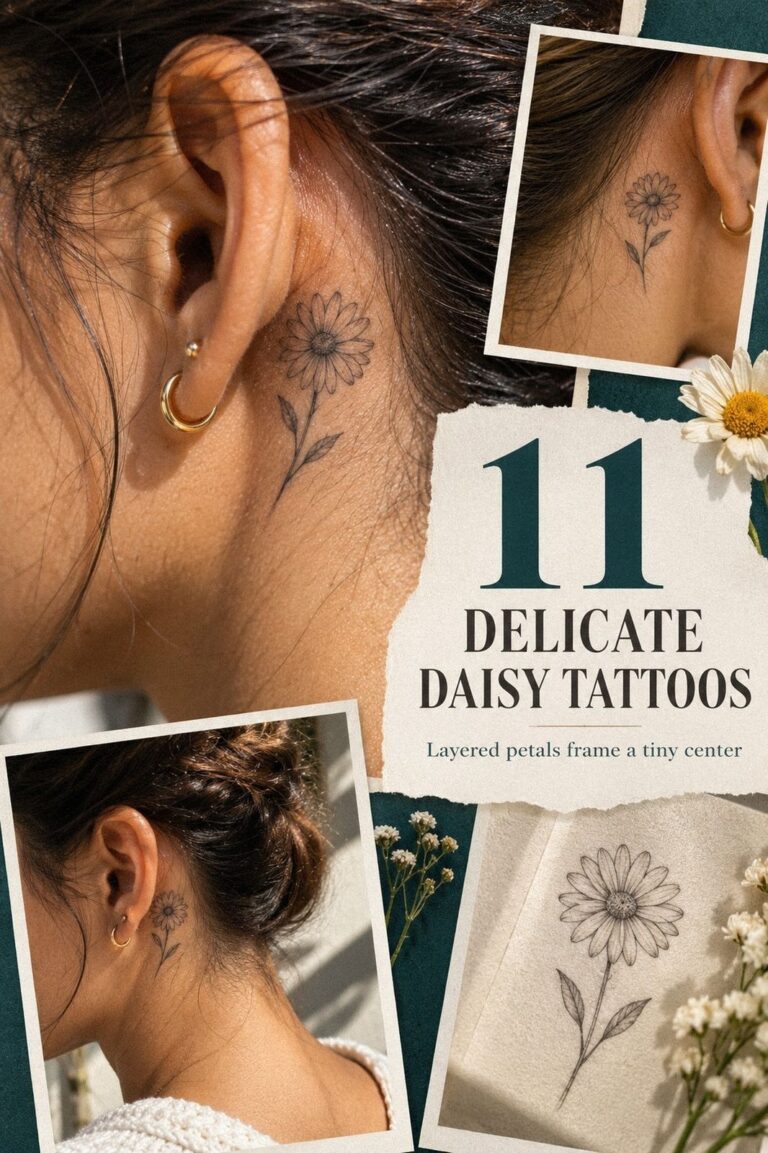
- Hide a Minimalist Fine Line Daisy Behind the Ear
- Is White Ink Daisy Work Actually Worth It on Fair Skin?
- Wrap a Dainty Daisy Chain Around the Ankle
- Read the Symbolic April Birth Flower Daisy Design
- Scatter a Whimsical Daisy Sprig Along the Collarbone
- Choose Bold Blackwork Over Hairline Fine Line on the Finger
- What Does Each Placement Actually Cost?
- Blend a Watercolor Daisy Splash on the Shoulder Blade
- Match Daisy Tattoos With Sisters and Best Friends
- Frame a Geometric Daisy With Crisp Linework
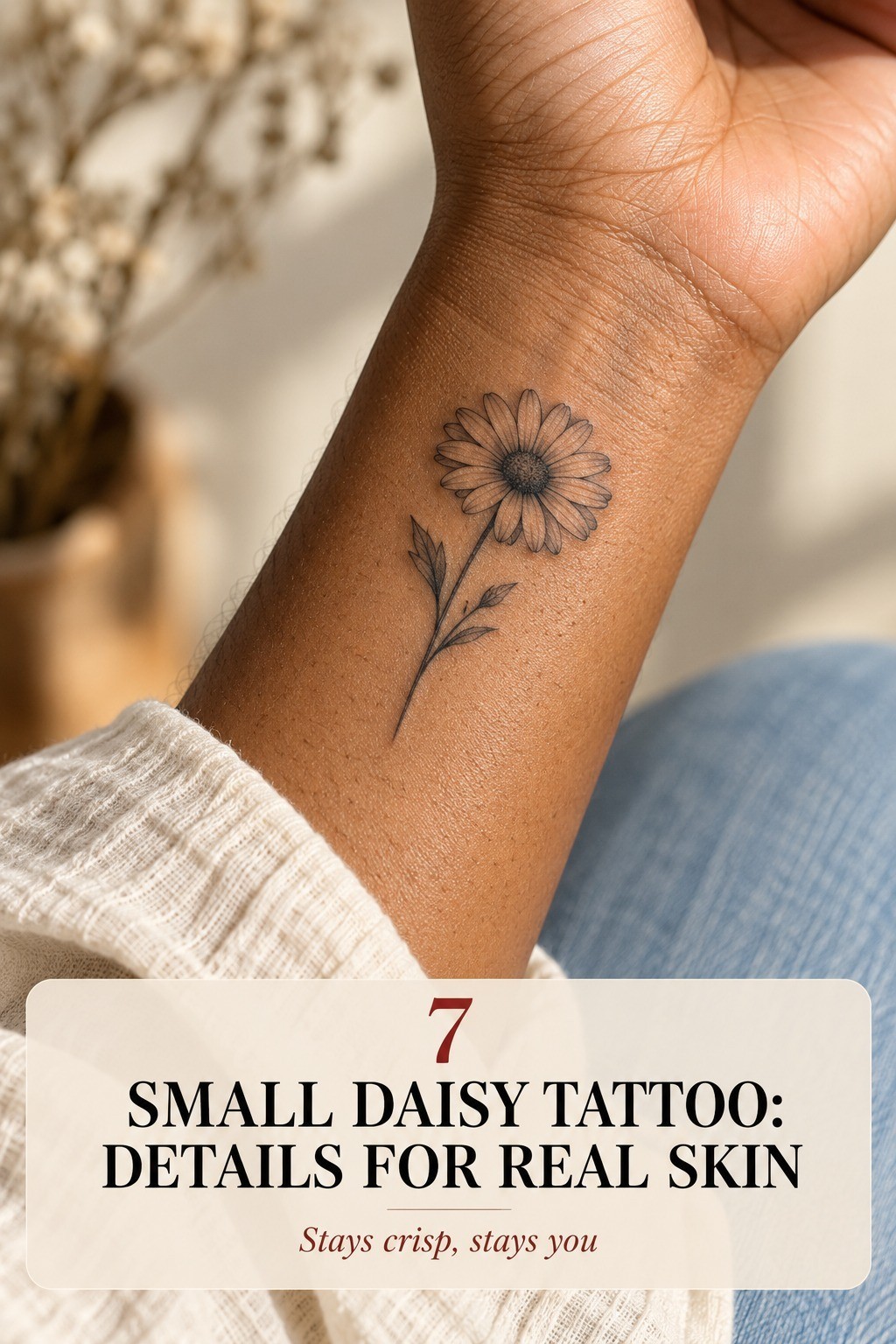
1Anchor a Delicate Single Daisy on the Inner Wrist

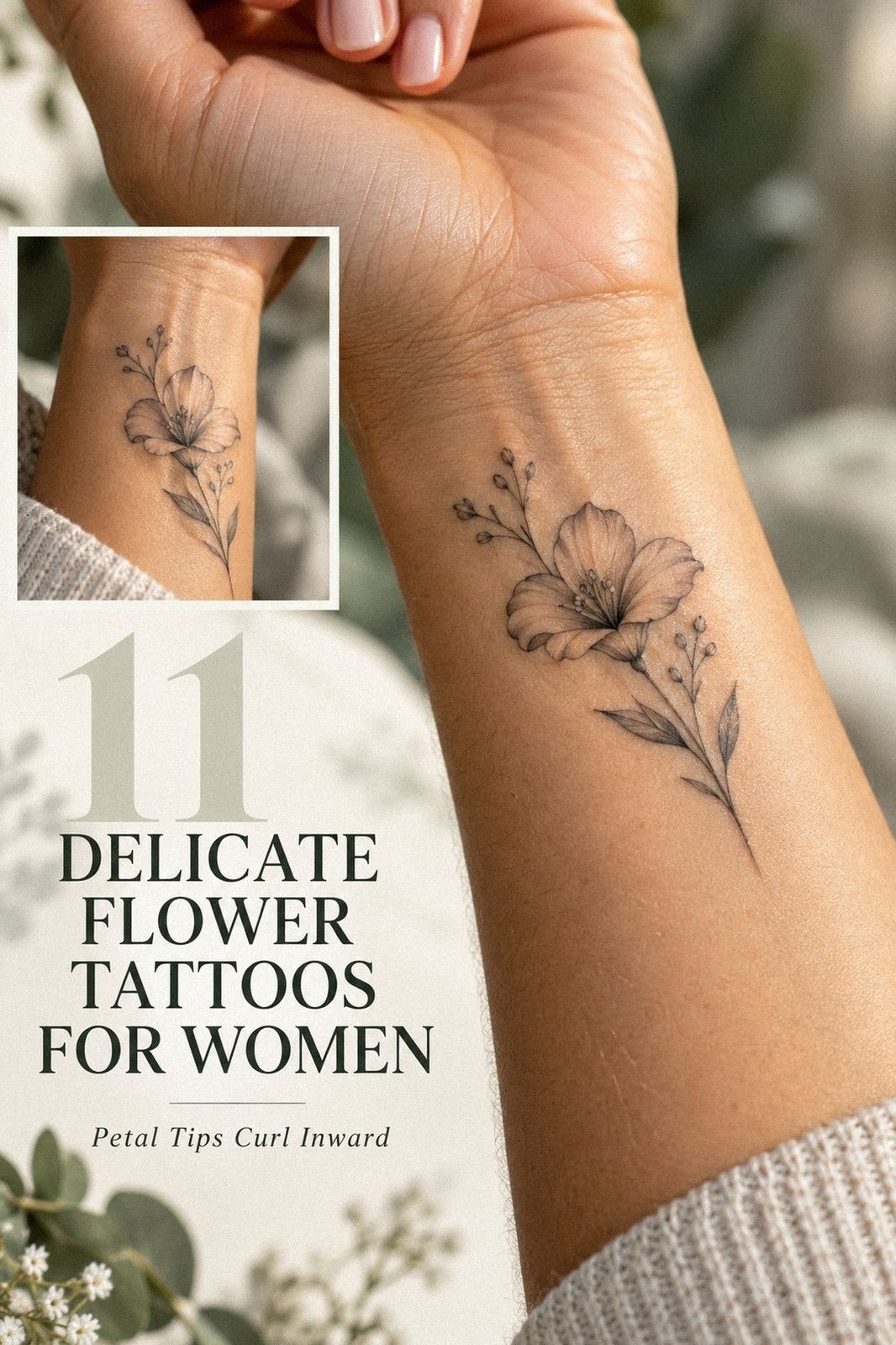
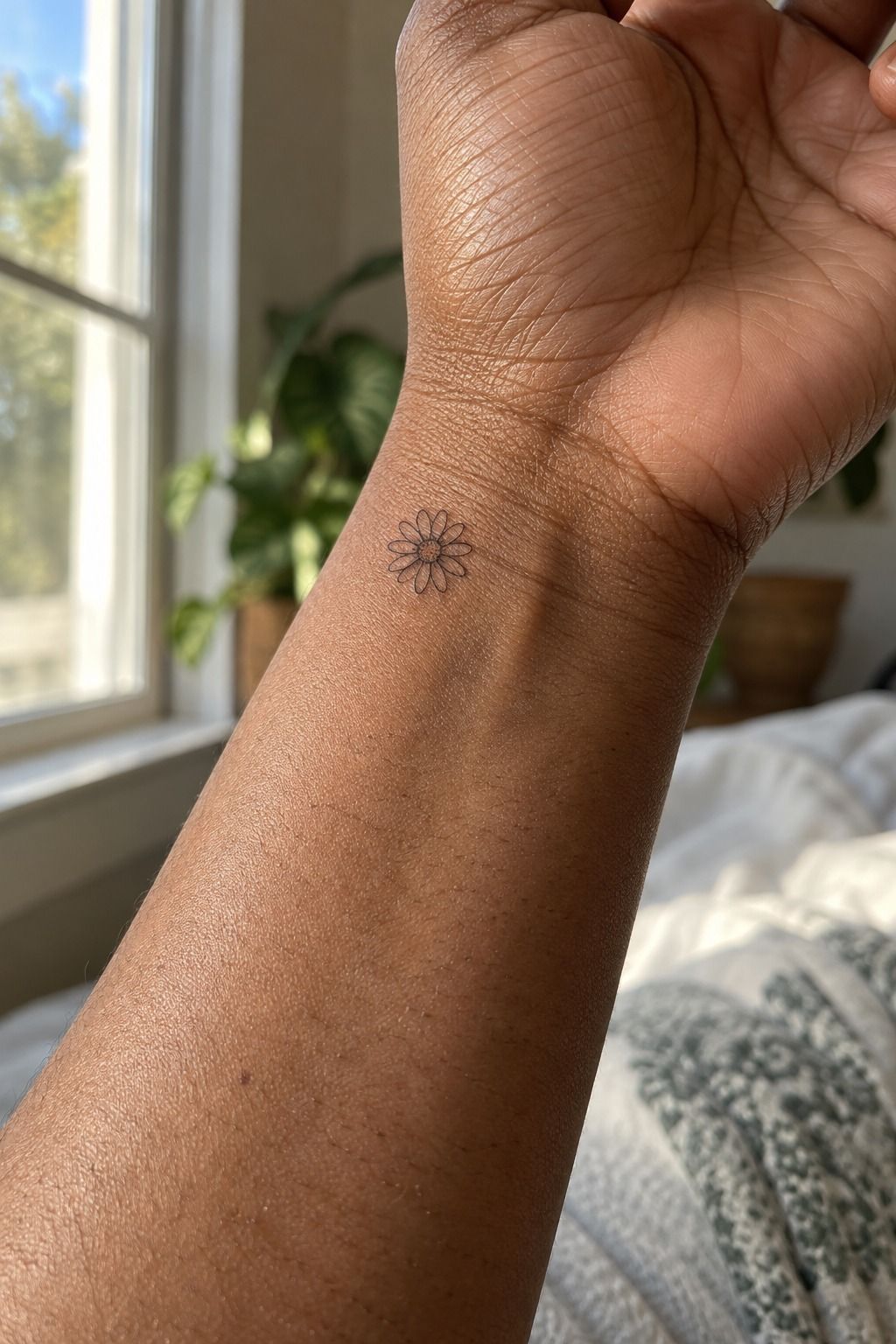
The inner wrist is where I’d send anyone getting their first small daisy tattoo, and I don’t say that lightly. On fair cool-pink skin, a single-needle black line reads crisp instead of muddy, and the skin there takes ink evenly because it’s thin and rarely sun-hit.
One daisy. Rounded petals, a dotted centre, maybe half an inch across.
The mistake I made was asking for too many petals. Eight felt full on paper and turned into a grey smudge after three years, because fine lines spread as they settle.
Five or six petals with real gaps between them stays legible. If you’re weighing this against other tiny florals, our guide to small flower tattoo ideas for women lines the options up side by side.
Sit for forty-five minutes, tops. At $120 to $180 it’s the best value on this list, and yes, worth it.
2Hide a Minimalist Fine Line Daisy Behind the Ear

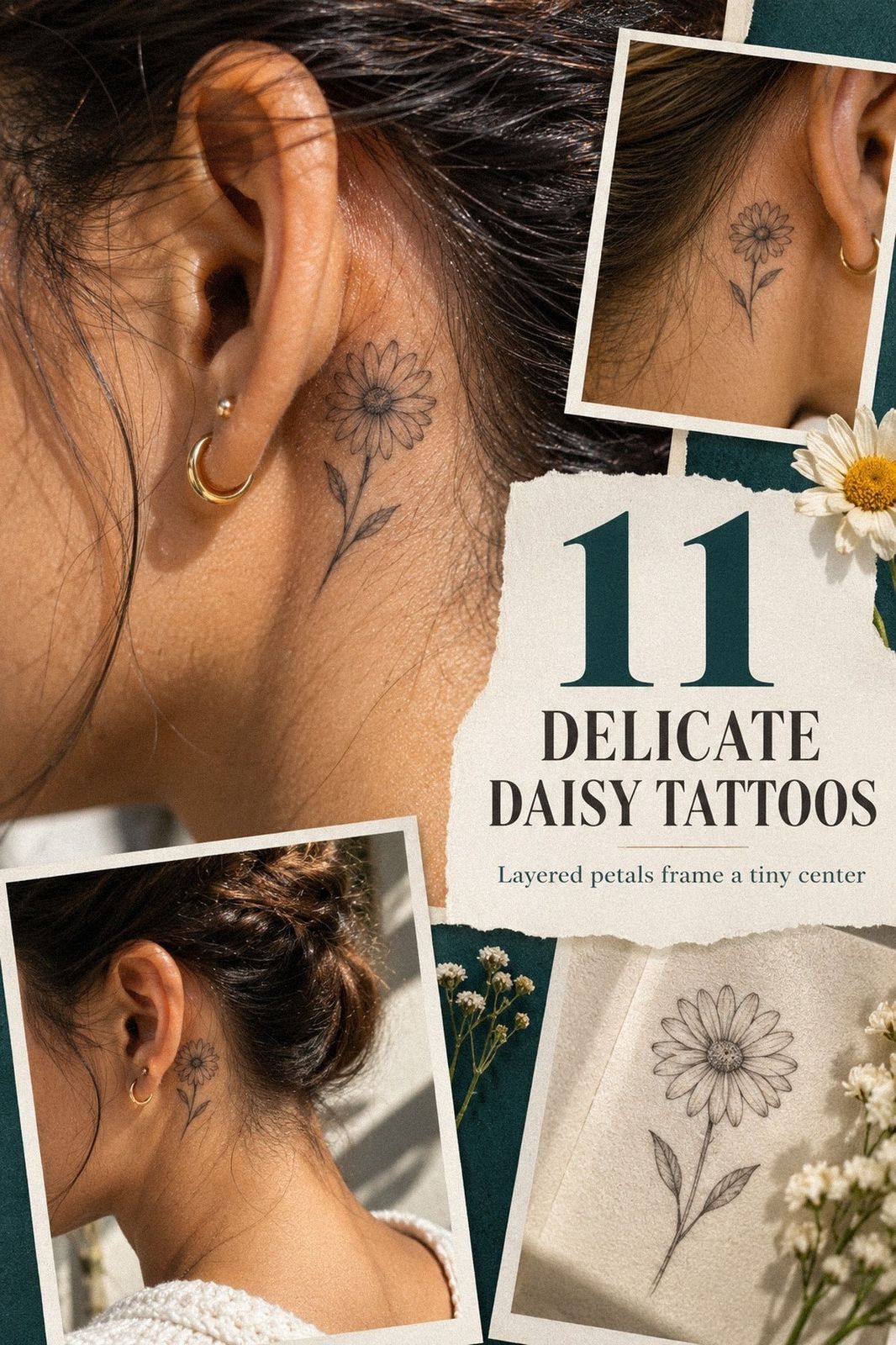
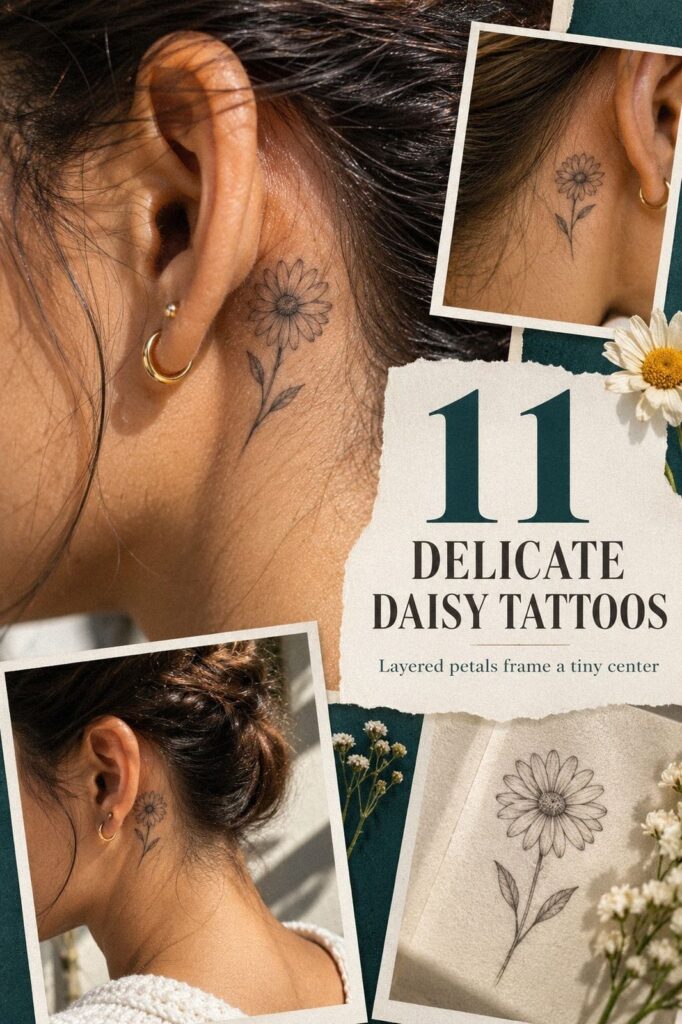
Behind the ear is the placement people gasp at, because they never see it coming until you tuck your hair back. On medium warm ivory skin, a minimal daisy with a dotted centre sits softly against the mastoid bone, and that bone is exactly why you should know what you’re signing up for.
It stings. Bony zones hurt more than fleshy ones, and the buzz travels straight into your jaw, which is a gentle way of saying bring a podcast.
But it’s a fifteen to twenty-five minute piece for most artists, so the ordeal ends fast. Ask for slightly thicker linework than you think you want.
Skin behind the ear is thin and mobile, and hairline-thin strokes there blur faster than on your forearm. A subtle daisy you can still read at arm’s length in ten years beats an ethereal one that fades into a bruise.
Most shops charge their minimum here, so the cost lands near $80 to $150, cheap for something this striking.
3Is White Ink Daisy Work Actually Worth It on Fair Skin?

White ink is the one everyone romanticises and almost nobody explains honestly. On the inner forearm, especially on medium olive skin, white pigment sits under the surface and reads more like a delicate scar than a drawing. That’s the charm.
That’s also the risk.
Here’s the part nobody respects: white ink can yellow, and it can vanish entirely under UV exposure. I’d skip pure white for a first piece and ask instead for a soft grey wash outline with white highlights inside the petals. You keep the understated effect and you keep a readable shape in five years.
Healing runs the same as any fine line piece, roughly two to three weeks on the surface. And no pools, no tanning beds, no shortcuts on that timeline.
Is it worth the budget? Only if you’re going in knowing you may pay $100 to $200 again for a touch-up inside three years.
4Wrap a Dainty Daisy Chain Around the Ankle
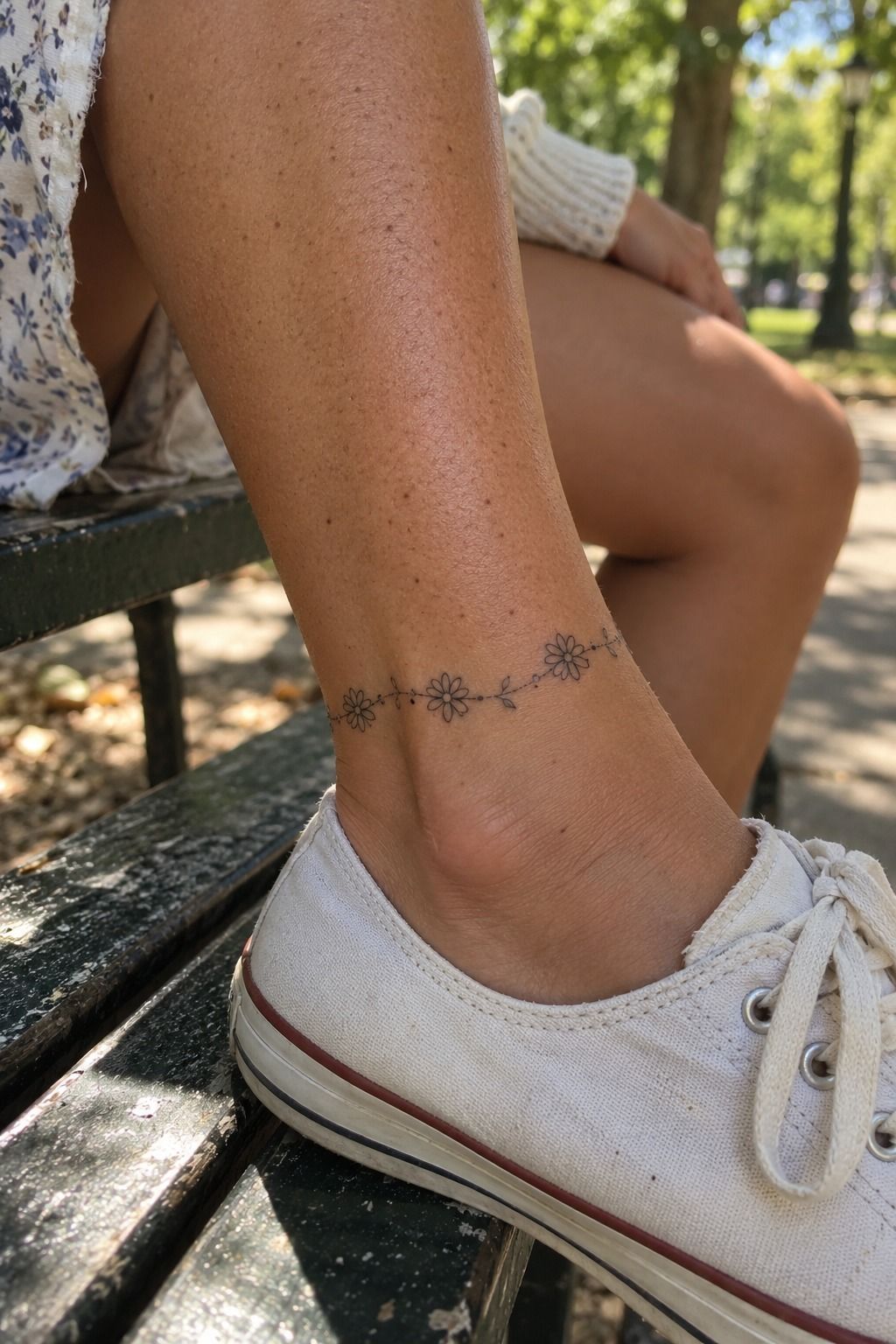
A daisy chain around the ankle is the piece that makes people smile in the grocery store line, and I’ve never met anyone who regretted one. On golden tan skin, a run of three to five small daisies linked by a hair-thin stem reads flowing and playful, like something you’d have made at eight years old in a field.
Wrap placement takes planning. Ask your artist to stencil it on and then walk around the studio for five minutes, because an ankle chain that looks graceful when you’re seated can bunch strangely when you stand.
The inner ankle hurts less than the bone on the outside. Budget ninety minutes to two hours for a full wrap, and expect a shop minimum somewhere in the typical US range of $50 to $100 if yours is tiny.
My ankle piece peeled like a sunburn for nine days straight and looked terrible on day six. It’s fine now. Panic on day six is normal!
5Read the Symbolic April Birth Flower Daisy Design

The daisy is April’s birth flower, and that’s the meaningful layer that keeps this design from being just a flower. Flash sheets make the point better than I can. A full page of hand-drawn daisies in black linework shows you the same symbolic subject solved eight different ways: some ornate, some raw, some reduced to three strokes.
Pick from flash if you can. It’s cheaper, it’s faster, and the design has already been drawn by someone who knows how their own lines heal.
Custom is for when you need a date, an initial, or a second flower woven in. If you want the full story behind what this flower stands for, we broke it down in our daisy tattoo meaning guide, and our flower tattoo symbolism page widens it out.
Innocence, new beginnings, loyal love. Not bad for something the size of a quarter.
6Scatter a Whimsical Daisy Sprig Along the Collarbone
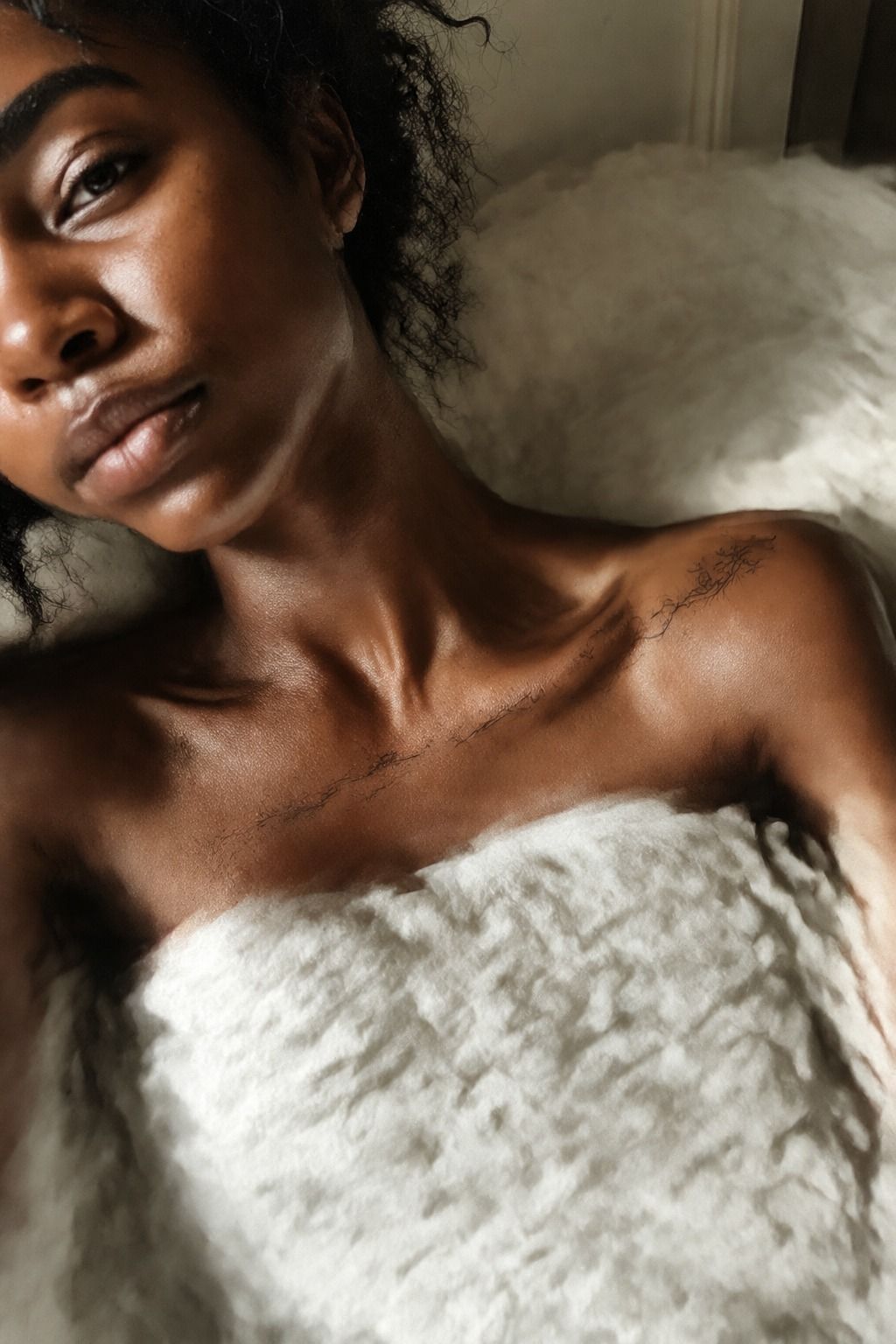
Collarbone daisies are the most elegant placement on this list, and on deep ebony skin a clean fine line sprig looks timeless in a way wrist pieces never quite manage. The sprig follows the bone, three or four blooms trailing toward the shoulder, each with a dotted centre.
Contrast is the whole conversation here. On richly pigmented skin, hair-thin grey lines can disappear, so a skilled artist will run solid black linework slightly bolder and let the negative space do the shaping.
Look at healed photos in their portfolio on skin like yours. Not fresh ones. Fresh work looks sharp on everybody.
And the collarbone is bony, so it’s a spicier sit than your forearm, though most sprigs wrap up inside an hour at $150 to $250. Pair it with the graceful feel of a small wildflower tattoo if you want to extend the piece later, or study proportion in our dainty floral tattoo placement breakdown.
7Choose Bold Blackwork Over Hairline Fine Line on the Finger

Finger tattoos are the placement I’d talk most people out of, so let me be straight with you. On fair cool-pink skin, a bold blackwork daisy silhouette, filled solid, is the only version that survives. Hairline fine line on a finger fades to grey confetti within two years, because your hands wash, scrub, and sun themselves more than any other part of you.
Go solid black fill with fierce, chunky petal shapes and no interior detail. Skip the dotted centre. Skip the stem.
Fingers are also genuinely painful, all bone and nerve endings, and the sides near the joints are the worst of it. Plan on touch-ups.
Most artists say finger work needs a refresh every two to three years, at $60 to $120 a visit, and many won’t guarantee it at all. That’s honest, not discouraging. If you want the iconic look and you accept the maintenance cost, it’s a striking piece. Our tattoo aftercare guide has the hand-washing workaround.
8What Does Each Placement Actually Cost?

Here’s the whole list side by side, because the honest answer to “what should I get” usually comes down to pain tolerance and budget rather than taste. Numbers below are US averages from studios charging $100 to $250 an hour.
Read the cost column against the ages-best column, not on its own. A $60 finger daisy you re-ink four times isn’t cheaper than a $180 wrist piece you never touch again.
That’s the only budget maths that matters here. If you’re pricing a bigger plan, our tattoo cost guide breaks hourly rates down by region.
9Blend a Watercolor Daisy Splash on the Shoulder Blade

Watercolor is the style that divides tattoo artists more than any other, and I’ve gone back and forth on it for years.
10Match Daisy Tattoos With Sisters and Best Friends
My sister and I did this badly the first time. We picked identical stencils, same size, same placement on the same wrist, and the result reads less like a personal bond and more like a uniform. Matching works better as variation on a theme than as duplication.
Give each person their own placement and their own petal count. One raw three-petal micro daisy on a wrist crease, one ornate five-petal bloom behind an ear, same artist, same line weight.
That shared weight is the thread that makes them read as a set without reading as a copy. Book the sittings back to back, because the second person always wants to change something after watching the first, and a good artist will let them. Two small pieces in one appointment usually costs less per person than two separate visits, so the value argument is on your side too.
Worth asking about at booking! Our matching sister tattoos roundup has more paired layouts.
11Frame a Geometric Daisy With Crisp Linework
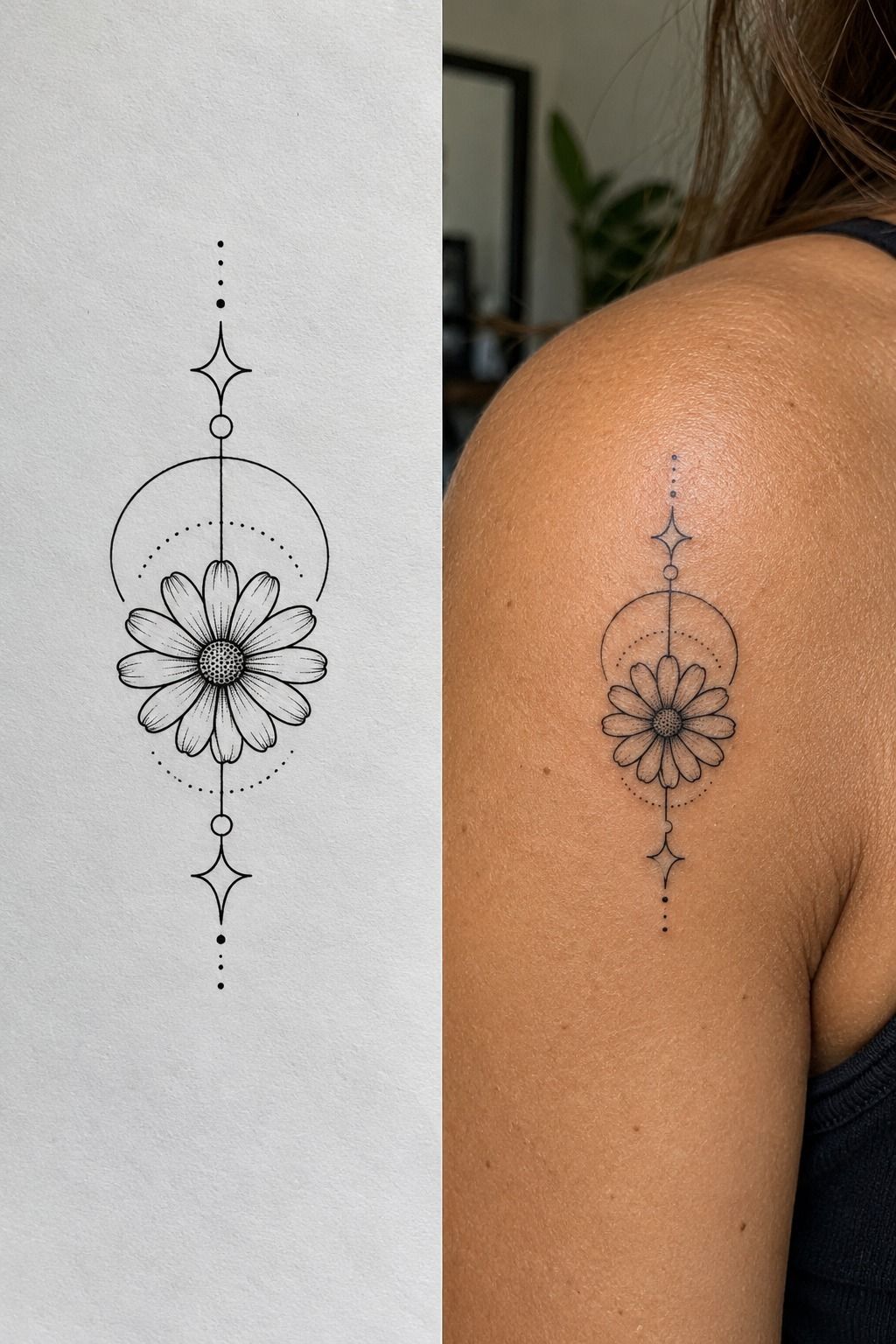
Geometric framing is the most underrated approach to a unique small daisy tattoo, and the split between stencil and healed result tells you why. On paper the design looks architectural: a daisy centred inside a thin circle, or bracketed by two clean parallel lines. Healed on skin, that frame is what holds the eye.
The frame does structural work, not just decorative work. A geometric border gives the eye a hard edge to read against, so when the interior fine lines soften over a decade, the piece still reads sharp.
That’s the whole argument for it. Ask for the circle at a consistent weight, drawn with a steady hand rather than a stencil trace, because a wobble in a perfect circle is far more visible than a wobble in a petal.
A refined single-line frame around a simple bloom might be the most polished version of this design I’ve seen. Our small lotus flower tattoo piece covers similar geometry if that’s your direction, and the geometric flower tattoo guide has the compass-work detail.
Tuck a Micro Daisy Inside the Wrist Crease
The wrist crease is the sneakiest placement on this list and my personal favourite. On deep brown skin with a warm undertone, a micro daisy tucked right into the fold reads almost sacred, visible only when you turn your palm up.
Micro means under half an inch, and at that scale you have maybe four or five lines to work with. Any more and they’ll merge.
I’d ask for three rounded petals suggested rather than five drawn, plus a dot. The crease itself moves constantly, so ink placed directly in the fold can wear unevenly.
Sit it just above or just below the crease line, not in it. That’s the detail most people miss. Sessions here are quick, twenty minutes, and the pain is mild compared to the bony wrist bones on either side. It’s an intimate piece at $80 to $140.
Nobody notices it until you show them, which is sort of the whole point of this list!
Does Petal Count Change How a Daisy Ages?
More than almost anything else you’ll decide. I learned this the expensive way, and the maths is simple once someone spells it out for you. Every petal you add steals gap space, and gaps are what keep a bloom legible after the ink settles.
At five petals on a half-inch daisy you get roughly a millimetre of clean skin between strokes, which survives a decade of spread. At eight you get a third of that, and the petals fuse into a dark rosette.
Artists who work small all day will tell you the same thing without prompting: fewer, bolder, further apart. A dainty three-petal suggestion reads more graceful at micro scale than a full ornate bloom crammed into the same footprint.
Which Daisy Placement Suits Your Pain Tolerance?
Be honest with yourself before you book, because pain tolerance decides more outcomes than style does. If you flinch at a blood draw, start on the shoulder blade or the inner forearm.
A 3 out of 10, all muscle, no bone under the needle. You’ll sit still, the artist works clean, and the line comes out sharp.
Bony placements ask more of you. The finger, collarbone, and sternum sit at 7 to 9, and the problem isn’t the pain itself but the flinching, which is what makes a delicate line wobble.
A twenty-minute sit on a bony spot is fine for almost anyone. A two-hour one is not.
Split a longer wrap into two sessions rather than pushing through, even if it costs a little more in shop minimums.
Should You Pick Flash or Commission a Custom Daisy?
Flash is the underrated budget move, and it’s what I’d point a first-timer toward. A sheet daisy costs $80 to $150 flat, it’s already drawn by an artist who knows how their own lines heal, and you walk out the same day. The value there is hard to beat.
Custom earns its cost when you need something woven in. A date, an initial, a second bloom, a specific ratio for your wrist width.
Expect a $50 to $100 design fee on top of the session, plus a week or two for the drawing. Ask to see the sketch before the stencil goes on.
Both routes make a meaningful piece; only one of them makes it specifically yours.
How Do You Keep a Fine Line Daisy Sharp for Ten Years?
Sunscreen. That’s the boring answer, and it’s the one that actually works. Broad-spectrum SPF 30 over healed ink, every time that patch of skin sees daylight, does more for a delicate line than any aftercare balm on the shelf.
The rest is habit. Moisturise the area so the skin stays supple, skip the tanning beds entirely, and don’t let a scrubby exfoliant near a tiny piece.
UV fades black pigment to a soft blue-grey, and on hairline work that’s the difference between crisp and haunting. Expect one touch-up around year five on a hand or foot placement, rarely any on a wrist or shoulder.
Book it with the artist who drew it, because matching someone else’s line weight is harder than it sounds.
Where Timeless Symbolic Daisies Beat Trendy Ones
Trends move fast in tattooing, and a daisy is one of the few motifs that’s never really been trendy, which is exactly why it holds up. Five petals and a dot has read the same way for a century. Compare that to the micro-realism wave or the heavy ornamental blackout look, both stunning, both very legible as a specific decade.
The timeless version is the reduced one. Fewer strokes, cleaner gaps, no shading you’ll have to explain in fifteen years.
Our timeless floral tattoo guide argues the same case with bigger pieces. If you want something expressive and current, keep that energy in the placement rather than the drawing.
The sternum or the spine reads daring without dating the ink itself.
What Should You Ask Before the Needle Goes Down?
Four questions, and they take ninety seconds. Can I see healed photos on skin like mine?
What line weight are you drawing for? How will this look at year ten?
Do you do your own touch-ups?
A good artist answers all four without getting defensive, because these are the questions they wish more clients asked. An artist who brushes them off is telling you something useful.
I’d also ask about the stencil: whether you can stand up, move, and look at it in a mirror before they commit. Thirty seconds of walking around has saved me from one badly angled piece already, and it’s free.
What I’d Tell You If We Were Sitting in the Shop Together
I’ve watched a lot of people walk into a studio with a photo on their phone and walk out with something that doesn’t look like the photo. It’s almost never the artist’s fault. It’s the gap between what a fresh tattoo looks like and what a healed one looks like, and nobody sets that expectation properly.
Here’s the thing about fine line daisies specifically. They photograph beautifully at day one.
Crisp, dark, impossibly delicate. Then they settle, and settling means the ink spreads a fraction inside the skin, which is normal and unavoidable.
A line that measured hair-thin fresh will read maybe thirty percent softer once it’s healed. Good artists draw for the healed state.
They leave gaps you think are too wide and use a weight you think is too heavy, and six months later you understand why.
The second thing: your skin is not a print surface. Tone, undertone, and how you heal all change the outcome, and any artist who doesn’t want to talk about that with you before the needle goes down isn’t the right artist.
On deep skin, contrast comes from bolder black and smart negative space, not from pushing harder. On fair skin, the same needle depth can leave a line that looks harsh for the first month.
This isn’t a limitation, it’s just information. The best small daisy tattoo ideas account for it before the stencil goes on.
And the last thing, the one I wish someone had said to me. You don’t need it to mean anything. Mine doesn’t, really.
I liked the shape, I liked the way a dotted centre catches light, and I liked that it was small enough to be mine before it was anyone else’s business. Meaning tends to arrive afterwards anyway, usually attached to the day you got it rather than the flower itself. If you want the symbolic weight, April’s birth flower gives you plenty to work with.
If you don’t, a daisy is still a daisy, and that’s enough.
A Few Things Worth Answering
How much does a small daisy tattoo usually cost?
Most small daisy pieces land somewhere around $100 to $300 in the US, depending on size and placement. Shop minimums typically run $50 to $100, and hourly rates sit around $100 to $250. Your artist’s experience and your region swing it either way.
Is a small daisy tattoo a good idea for a first tattoo?
Yes, and it’s one of the better first choices out there. Clean linework, a short sit, and placements like the forearm or shoulder that are genuinely tolerable.
The shape stays readable as it ages, which is more than you can say for a lot of first tattoos. Start small, add later.
How do I choose a tattoo artist for a daisy piece?
Look at healed photos, not fresh ones. Healed work tells the truth about how their lines hold.
Check that fine line or blackwork is actually their specialty rather than an occasional job, watch the studio’s hygiene, and read reviews. Our small peony tattoo guide covers vetting too.
How much does a small daisy tattoo hurt?
It depends entirely on where you put it. Ribs, feet, hands, and the sternum are the sharp ones, all bone and nerve.
Forearm, thigh, and shoulder are the most tolerable zones by a wide margin. Wrist and collarbone sit in the middle.
Most small daisies are done in under an hour.
How long does a small daisy tattoo take to heal?
The surface closes up in roughly two to three weeks, but full healing takes two to three months under the skin. Wash gently with unscented soap, moisturise lightly, and stay out of pools and direct sun the whole first month. Don’t pick the flakes, no matter how tempting.
What’s the best placement for a small daisy tattoo?
Inner forearm and shoulder, if I’m picking for longevity. Both age well because the skin there stays covered and stable, and neither is a brutal sit.
The wrist is the crowd favourite for visibility. Fingers look iconic and fade fastest.
Browse our small floral sleeve tattoo ideas for building outward later.
The One I’d Book First
If I had to pick one, I’d start with the inner wrist. Fine lines there sit on thin, stable, rarely-sunned skin, so they hold their shape longer than anywhere else on this list, and at $120 to $180 the value is obvious. Pin it for later and browse our small flower crown tattoo ideas next, or the minimalist tattoo ideas set if you want more understated work.