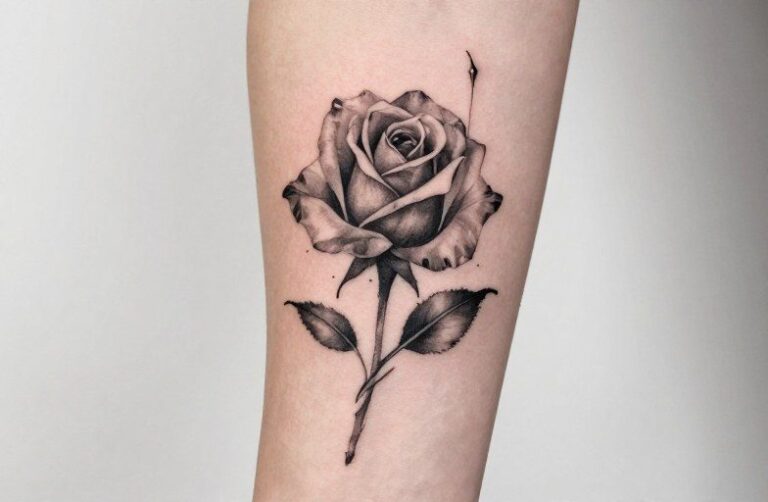
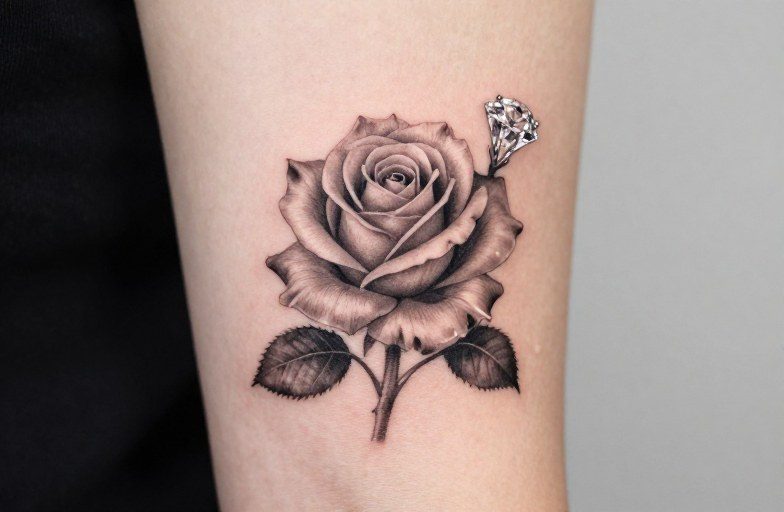
A rose and diamond tattoo typically represents the balance between vulnerability and resilience, beauty that endures, love that withstands pressure. The rose speaks to passion, growth, and the temporary nature of life; the diamond signals permanence, clarity, and what survives transformation. Together, they create a layered symbol about holding onto what matters through hardship.
Symbolism & Core Meaning
Each element carries weight on its own, but their pairing creates something neither achieves alone.
The Rose: Beauty That Opens and Fades
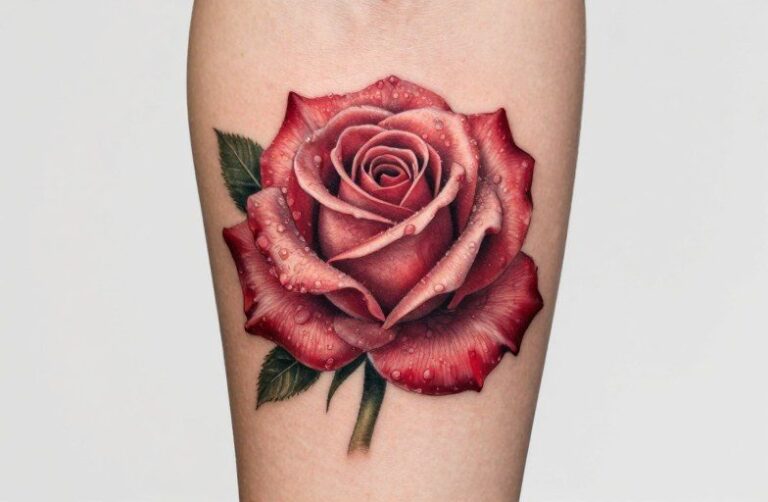
Roses in tattooing draw from centuries of coded meaning. Red roses signal romantic love and courage; black roses mark loss or rebellion; yellow roses, friendship and jealousy. The thorns matter as much as the petals, they’re the reason a rose isn’t just a pretty flower. In a combined design, thorns often wrap around or protect the diamond, suggesting that difficulty guards what’s precious.
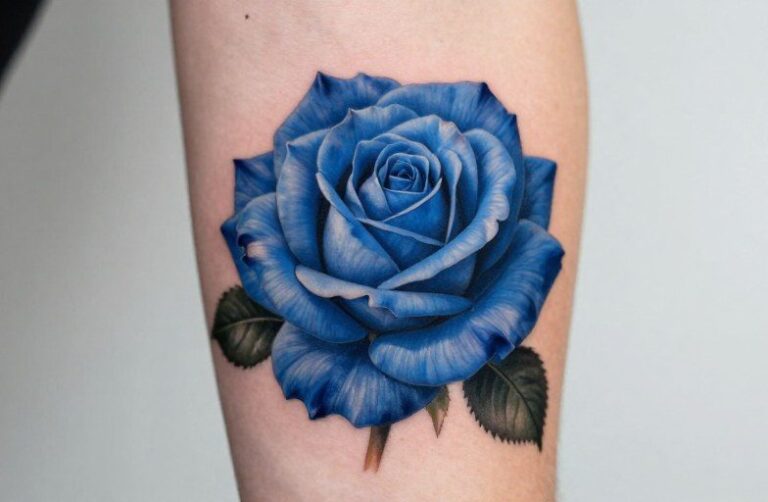
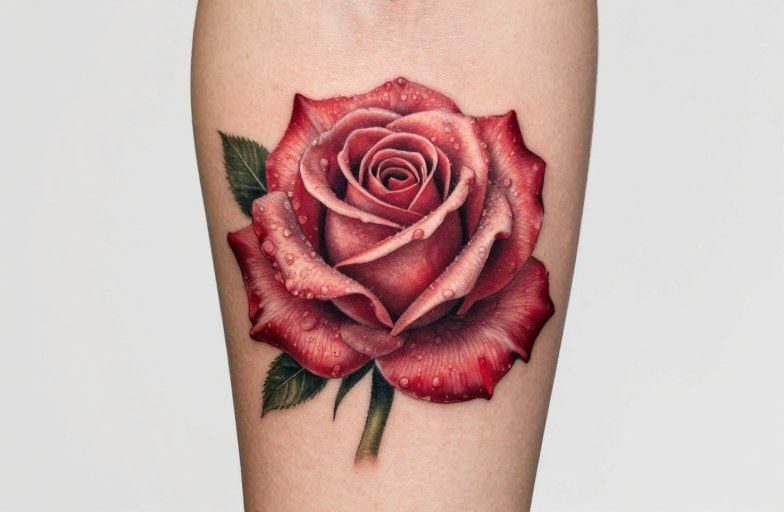
- Color choice dramatically shifts meaning: deep crimson reads passionate, pale pink reads tender, white reads memorial or pure intention
- Closed buds suggest potential or new beginnings; fully bloomed roses acknowledge maturity or peak experience
- Dropping petals, often included in more realistic designs, acknowledge impermanence without surrendering to it
The Diamond: What Pressure Creates
Diamonds form under extreme heat and pressure over millennia. That geological reality shapes their symbolic use: they represent endurance, clarity, and value refined through struggle. In tattoo composition, diamonds frequently appear faceted rather than raw, emphasizing the finished result of transformation rather than the raw process. Some designs contrast this by showing a diamond still in matrix rock, paired with a rose in similar unfinished state, both becoming.
History & Cultural Roots
The pairing of flowers and precious stones has decorative roots in Victorian-era jewelry, where “language of flowers” (floriography) combined with gemstone symbolism to create coded messages in brooches and rings. A rose with a diamond in a locket might signal enduring love that outlasts death. Tattooing adopted and stretched these combinations, freeing them from material luxury and making them personal rather than performative.
From Sailor Traditions to Contemporary Work
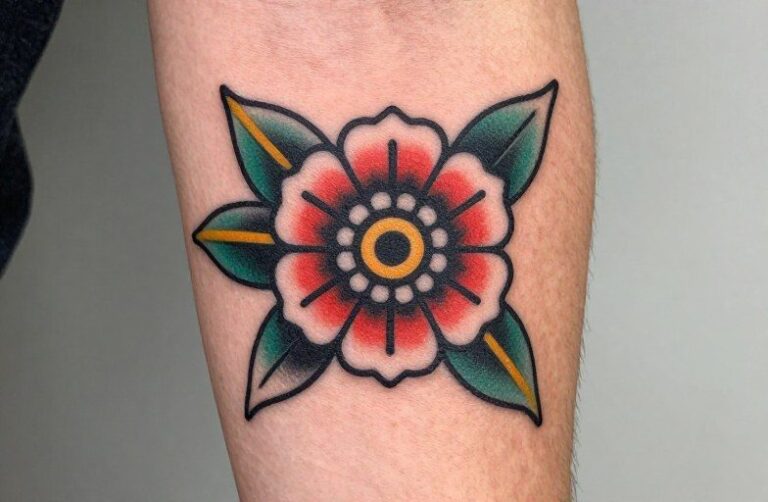
Traditional American tattooing often paired roses with daggers, skulls, or banners, masculine-coded symbols of risk and mortality. The diamond entered this visual vocabulary later, often linked to post-WWII prosperity imagery and the growing accessibility of gemstone tattoos as symbols of aspiration. Contemporary artists now render both elements with techniques unavailable to earlier generations: single-needle faceting, color realism in petal gradients, and the deliberate contrast of soft organic forms against hard geometric ones.
Religious & Spiritual Angles
Several traditions offer frameworks for understanding this combination.
Christian Iconography
The rose carries strong Marian associations, the “mystical rose” titles for the Virgin Mary connect to purity, divine love, and secrecy. The diamond, less directly biblical, enters through its properties: unbreakable, clear, precious. Some contemporary Christian tattoo wearers frame the combination as grace (the rose, given freely) perfected through trial (the diamond, formed through fire). The Sacred Heart, sometimes depicted surrounded by thorns and sometimes by light, offers a visual precedent for combining woundedness with radiance.
Buddhist and Hindu Perspectives
The lotus often replaces the rose in Eastern symbolism, but the underlying structure, beauty emerging from difficulty, translates. Diamond-related concepts appear more directly: vajra in Sanskrit means both thunderbolt and diamond, naming a ritual object and a quality of indestructible clarity. Some trace the diamond’s spiritual associations to this linguistic connection, though direct tattoo symbolism rarely invokes these specific textual roots.
Mythology & Folklore
Greek mythology offers the rose’s origin through Aphrodite, often linked to Adonis’s blood or her own tears, beauty born from pain and love’s cost. The diamond lacks comparable mythic narratives, which may explain why it often serves as setting or frame rather than narrative center in combined designs.
More productive is the folklore of combined materials. Medieval lapidaries (books on stones) sometimes claimed diamonds could only be cut by diamond, or that they tested true by resisting hammer blows, practical falsehoods that nonetheless shaped symbolic association with invulnerability. The rose, by contrast, bruises, browns, and drops. Their pairing in tattoo form often stages this tension: what breaks and what doesn’t, what you can afford to lose and what you can’t.
Personal & Modern Meanings
Contemporary wearers rarely adopt this combination for its historical pedigree. More common are personal frameworks that borrow symbolic language for individual circumstance.
Relationship and Commitment Markers
Some choose this pairing to mark relationships that survived difficulty, infidelity, long distance, illness, or simply time’s erosion. The diamond’s permanence promises; the rose’s fragility acknowledges what could have been lost. Placement matters here: over the heart reads more romantic, on the forearm or calf reads more self-contained, a reminder to oneself rather than a signal to a partner.
Self-Transformation Narratives
Recovery from addiction, surviving abuse, or major identity shifts sometimes find expression here. The diamond represents the self that emerged; the rose, the tenderness or beauty that survived alongside it. These designs often incorporate dates, initials, or small additional symbols (a semicolon, a phoenix feather) that specify the narrative without requiring explanation.
Who Chooses This Tattoo
No single demographic owns this combination, but patterns emerge in placement and style choices.
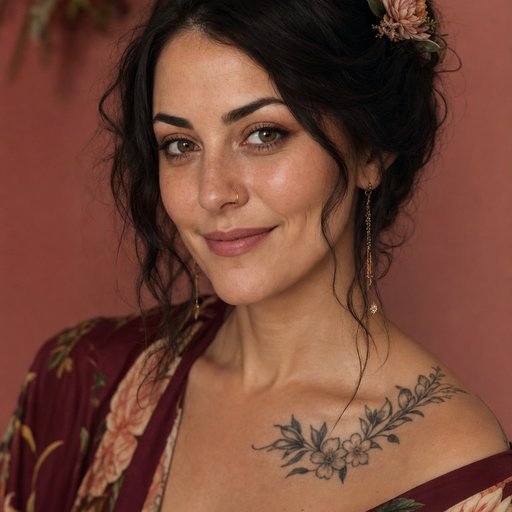
Women more often request softer renderings, watercolor roses with diamond accents, or the diamond as a small center element within a larger floral composition. Men frequently reverse the hierarchy: a prominent geometric diamond with a rose worked into its facets or as a secondary element. These aren’t rules, just observable tendencies in shop requests.
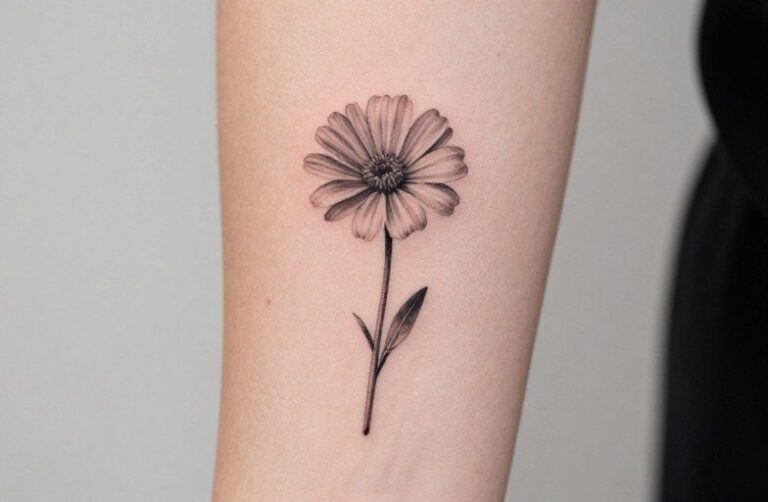
Age factors in execution preference. Younger clients often favor fine-line single needle work with delicate shading; older clients or those with existing traditional pieces may want bold lines and limited color that match existing work. The combination adapts to both.
Cover-up potential draws some specifically to this pairing. The diamond’s geometric structure can organize and disguise older work beneath, while the rose’s organic shapes soften edges and draw the eye away from any remaining ghost lines.
What to Remember
If you’re considering this design, a few practical specifics matter.
Line weight decisions shape longevity. Fine lines in diamond facets blur over five to ten years, especially on high-movement areas like wrists or ankles. Thicker outline or strategic black fill in facet junctions preserves readability. Roses face the opposite challenge: heavy black shading can muddy color layers, while too-light shading reads as unfinished. Experienced artists balance these competing demands.
Color choices carry aging implications. Reds and pinks in roses tend to hold better than yellows or pale peaches. Diamonds rendered in blue or black rather than traditional clear/white avoid the “dirty gray” problem that affects white ink over time. Skin tone affects all these choices; what reads as subtle on pale skin may disappear on darker tones, requiring adjusted saturation.
Scale matters for detail. A diamond the size of a quarter can hold meaningful facet work; much smaller, and it becomes a suggestive shape rather than a readable stone. Roses need room for petal layering to avoid “blob” syndrome. Most successful combinations occupy at least palm-sized real estate.
Healing reality: the geometric precision of diamonds shows every imperfection in healing, scabbing, moisture imbalance, or sun exposure during recovery. Roses are more forgiving; their organic forms accommodate slight variations. Plan aftercare accordingly, especially for hand or foot placements where daily life interferes.
Ultimately, this combination works because the tension between its elements mirrors lived experience: nothing purely fragile survives, nothing purely hard connects. The rose and diamond tattoo holds both truths without resolving them.
Frequently Asked Questions
Does a rose and diamond tattoo always mean romantic love?
Not necessarily. While many choose it for relationship significance, the combination also marks personal resilience, family bonds, or memorial purposes. The wearer’s intention and any accompanying elements determine specific meaning.
What’s the best placement for a rose and diamond tattoo?
Upper arm, thigh, and ribcage offer enough flat surface for detail in both elements. Hands and feet work but fade faster. Avoid areas with significant weight fluctuation if you want geometric precision to hold.
Should I get color or black and gray for this design?
Color makes the rose read more naturalistically and allows traditional red symbolism; black and gray emphasizes the diamond’s facets and creates a more unified, graphic composition. Consider your existing tattoos and long-term maintenance preferences.
How do I keep the diamond’s facets from blurring over time?
Start with sufficient line weight in facet boundaries, protect the tattoo from sun exposure with SPF, and consider touch-ups every few years. Avoid heavy moisturizers that can soften edges during healing.