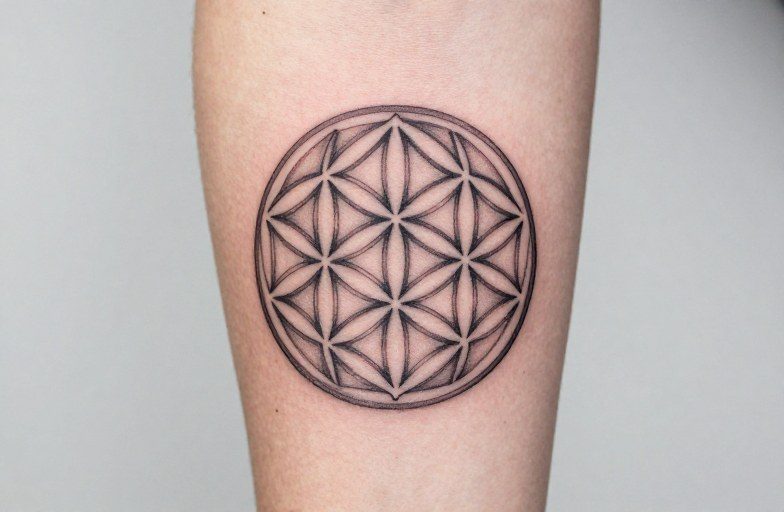
The Flower of Life tattoo represents the geometric pattern of overlapping circles that contains the blueprint for all creation, every living cell, molecular structure, and natural form. As a tattoo, it signals an interest in sacred geometry, a belief in universal interconnectedness, or simply an appreciation for one of the most visually complete symbols humans have found. The meaning tends to land somewhere between spiritual conviction and mathematical awe, depending on who’s wearing it.
Symbolism & Core Meaning
The Geometry of Everything
Seven overlapping circles arranged with six-fold symmetry. From this single pattern, you can derive the Seed of Life, the Egg of Life, the Tree of Life, and theoretically the five Platonic solids that form the basis of crystalline structures. The Flower of Life appears in ancient temple carvings from Egypt to China, though its origins are often linked to multiple traditions rather than any single source. On skin, it functions as a kind of compressed cosmology, a symbol that says the universe operates on discernible, repeating patterns.
Personal Resonance vs. Universal Claim
Some people get this tattoo after encountering it in meditation, psychedelic experience, or study of metaphysics. Others come to it through architecture, graphic design, or mathematics. The symbol accommodates both paths without contradiction. What matters for the tattoo is whether the wearer connects to its implications: that separateness is illusion, that the same patterns repeat from microcosm to macrocosm, or that beauty and order emerge from simple rules iterated across scale.
Color vs Black and Grey
Black and Grey: The Classic Approach
Most Flower of Life tattoos execute in solid black ink, sometimes with grey wash for depth. The precision of the geometry demands clean lines, and black holds that crispness better than color over decades. A well-done black Flower of Life reads almost like a technical drawing on skin, appropriate for a symbol that functions as nature’s blueprint. Single-needle or tight three-needle groupings work best for the fine intersecting circles; anything looser and the overlaps blur into indistinct grey masses.
Color Applications
Color enters the Flower of Life in several ways, each carrying different weight:
- Gradient fills between circles, creating a mandala-like effect
- Chakra color sequencing (red at center, violet outer) for energetic symbolism
- Dotwork or stipple shading in warm tones for organic warmth against geometric coldness
- Watercolor splashes behind the structure, preserving the geometry while adding movement
Color demands more maintenance. The fine lines between hues require touch-ups sooner, and bright pigments fade to muddy intermediates where circles overlap. If you want color, plan for refresh sessions every 3-5 years.
How It Ages on Skin
The Precision Problem
This is where the Flower of Life separates good tattoos from regrettable ones. The symbol relies on perfect circle geometry. Skin stretches, settles, and shifts. A circle that reads true on a flat stencil distorts over ribs, shoulders, or anywhere subcutaneous tissue moves. The aging trajectory is specific: fine lines spread, overlaps that once created distinct petal shapes merge into blobby hexagons, and the whole pattern can collapse into decorative noise within ten years if executed too small or too delicately.
Scale and Line Weight for Longevity
Minimum viable size for a complete Flower of Life (seven circles, full pattern) is roughly 3.5 inches in diameter. At that scale, line weight should be 3-5 needle, not single needle. Some artists build the pattern with dotwork instead of continuous lines, which ages more gracefully, the dots soften uniformly rather than lines blurring asymmetrically. Placement matters enormously here. Inner forearm, outer thigh, and upper back age most predictably. Fingers, elbows, and anywhere with frequent flexion will distort the geometry fastest.
Similar & Related Symbols
The Flower of Life sits in a family of geometric tattoos that often get confused or conflated. Understanding the distinctions helps clarify what you’re actually asking for:
- Seed of Life: The central seven circles of the Flower of Life, often used as a simpler, smaller tattoo with similar creation symbolism
- Tree of Life: The Kabbalistic diagram derived from the Flower of Life’s internal geometry; represents emanation of divine energy through ten spheres
- Metatron’s Cube: Formed by connecting the centers of Flower of Life circles; contains all five Platonic solids and reads more complex, more angular
- Sri Yantra: Nine interlocking triangles from Hindu tantra; similar meditative geometry but entirely different cultural lineage
- Vitruvian Man: Da Vinci’s proportional study; less about cosmic creation, more about human measure within nature
Many people combine the Flower of Life with one of these relatives, nesting the Tree of Life inside the complete pattern or using Metatron’s Cube as a sleeve’s central anchor. The combinations work when the geometry actually aligns, when it’s just visual collage, the symbol loses coherence.
Common Variations & Styles
Structural Modifications
The basic pattern invites alteration. Some tattoos use only partial Flowers, three-quarters of the complete pattern wrapping around an arm, suggesting infinite continuation beyond the visible edge. Others add dimensional depth, shading circles to read as spheres or building the pattern into apparent 3D space. The Merkaba (interlocking tetrahedrons) sometimes emerges from the Flower’s center, literalizing the symbol’s supposed capacity to generate solid forms.
Style Adaptations
Traditional tattoo styling doesn’t suit this symbol well, the geometry fights the organic weight of bold lines and limited palette. Where adaptation succeeds:
- Dotwork/mandala: Natural fit; the pattern essentially is a mandala already
- Geometric blackwork: Heavy, saturated black with negative-space circles; dramatic but loses the delicate overlap quality
- Fineline: Currently popular; emphasizes precision but requires larger scale and careful placement
- Sacred geometry sleeves: The Flower of Life becomes one panel in a larger mathematical narrative, often transitioning into astronomical or crystalline imagery
Best Placements
Flat Surfaces for Precision
The symbol’s integrity depends on relatively flat skin. Chest center, upper back between scapulae, outer thigh, and inner forearm offer the most stable canvases. These locations also allow the size needed for the pattern to remain legible. A complete Flower of Life smaller than 3 inches risks becoming a dark smudge within five years.
Flowing and Wrapping Options
Partial patterns adapt to curved anatomy better than complete ones. A half-Flower following the deltoid curve, or a band of repeating Seed-of-Life units wrapping a wrist or ankle, maintains recognizability without demanding flatness. The forearm’s inner and outer surfaces work well for vertical orientations, with the pattern’s natural hexagonal symmetry aligning to the bone structure.
Avoid: direct center of the sternum (too much movement with breathing), stomach (changes with weight), and anywhere bone sits directly under thin skin without muscle padding. The circles need some subcutaneous forgiveness to stay round.
Final Word
The Flower of Life tattoo works best when the geometry is respected, when scale, line weight, and placement serve the symbol rather than forcing it into convenient but incompatible spaces. Its meaning doesn’t require mystical belief; the pattern genuinely does describe structural principles found in cell division, crystal formation, and wave interference. That empirical reality gives the tattoo substance even for wearers who don’t truck with sacred geometry’s spiritual claims. Get it big enough, get it clean, and understand that this particular design punishes shortcuts more visibly than most. The symbol is ancient; your skin is temporary. The tattoo’s job is to hold the tension between those truths for as long as possible.
Frequently Asked Questions
Does the Flower of Life tattoo have to be perfectly symmetrical to work?
Near-perfect symmetry is essential to the symbol’s impact, since the geometry itself is the meaning. Minor human variation is acceptable and expected, but obvious asymmetry breaks the pattern’s integrity. Choose an artist with proven geometric work in their portfolio.
Can the Flower of Life be combined with other imagery without losing its meaning?
Yes, when the combination is geometrically coherent, nesting the Tree of Life inside, or transitioning to crystalline structures. Arbitrary additions like banners, animals, or text usually fight the symbol’s clean mathematics rather than enhancing it.
Is there a difference between getting the complete Flower versus just the Seed of Life?
The Seed of Life (central seven circles) contains the germ of creation symbolism in a simpler, more compact form. The complete Flower of Life extends to nineteen circles and implies fuller cosmic completeness. Both are valid; the choice depends on scale constraints and how much complexity you want.
Why do some Flower of Life tattoos look muddy after a few years while others stay crisp?
Three factors: initial line weight too fine for the scale, placement over high-movement areas, and insufficient size. The overlaps create dense ink concentrations that spread predictably. Prevention means slightly heavier lines than you think you need, flat placement, and minimum 3.5 inches diameter.