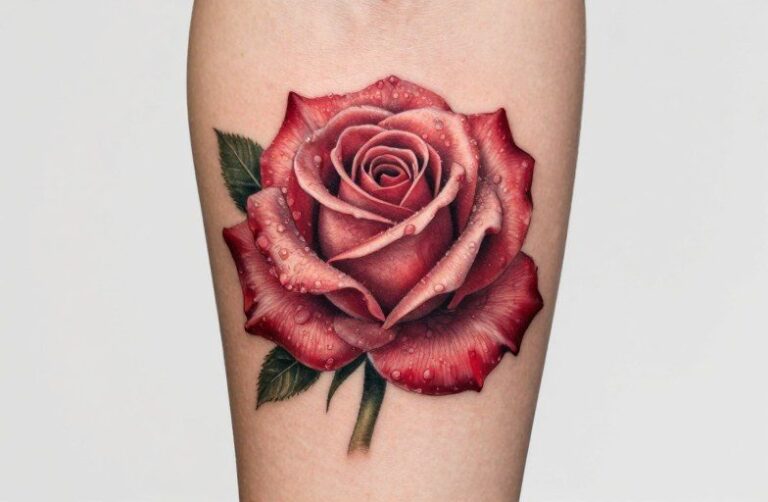
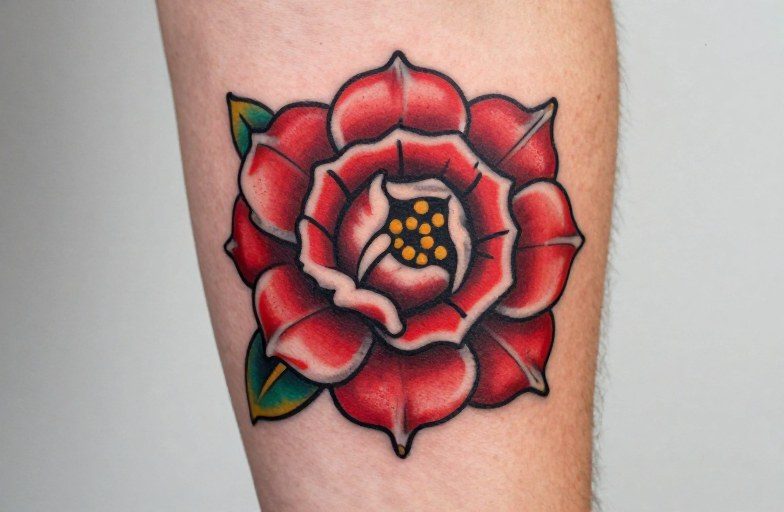
The Sailor Jerry rose tattoo carries meanings rooted in mid-20th-century American tattooing. the design signals romantic love and devotion, often worn by sailors as mementos of wives or sweethearts left ashore. The same image served as memorial ink for the dead, its thorns and drops of blood acknowledging that love and loss intertwine. Norman Collins, who worked as Sailor Jerry in Honolulu from the 1940s through the early 1970s, refined the bold-lined, limited-palette style that made these roses readable across a crowded bar or a distant beach.
Where to Place It
Where this design sits on your body shapes how it reads and how well it holds up. Sailor Jerry’s originals favored high-visibility spots that a sailor could display or conceal under regulation whites.
Upper Arm and Shoulder
The rounded muscle structure gives the rose natural dimension without forced perspective tricks. Outer bicep placement allows for a stem that trails toward the elbow or wraps into a larger nautical scene, snake, dagger, or banner. Inner bicep works too but sees more friction from arm movement and sun exposure when sleeves are short.
Forearm and Hand
Forearm roses announce themselves. The flat plane suits the design’s graphic quality, and the shape fills the space without awkward gaps. Hand placement, particularly the knuckles or back of hand, carries heavier social signaling, rebellion, outsider status, but ages fast. Skin here is thin, constantly in motion, and rarely protected from sun. Expect significant blur and fade within five to seven years unless you are meticulous about sunscreen.
Chest and Ribs
Central chest placement frames the heart literally, amplifying the romantic or memorial intent. Ribs offer a large, curved field for a bigger bloom with leaves and stem, but the stretching and compression of breathing stresses linework over decades. Bold Sailor Jerry outlines help; fine detail does not survive here.
- Thigh: excellent for larger compositions, less sun damage, easy to show or hide
- Calf: good visibility, moderate aging, works well with nautical surrounding imagery
- Neck and throat: high commitment, socially charged, skin ages visibly and quickly
What Makes It Authentic
Not every rose claiming Sailor Jerry lineage follows his visual formula. Understanding the authentic language helps you recognize quality work and communicate clearly with your artist.
The Classic Formula
True Sailor Jerry roses feature thick black outlines, a limited color palette of deep red, green, yellow, and black, minimal shading achieved through whip-shading or sparse black fill, stylized rather than botanical petals with pointed tips and central spiral, and accompanying elements like banners, daggers, snakes, or scrolls with lettering. The green is particular, often a blue-green rather than forest or lime, mixed to read clearly under Pacific sun and dim bar light.
Modern Interpretations
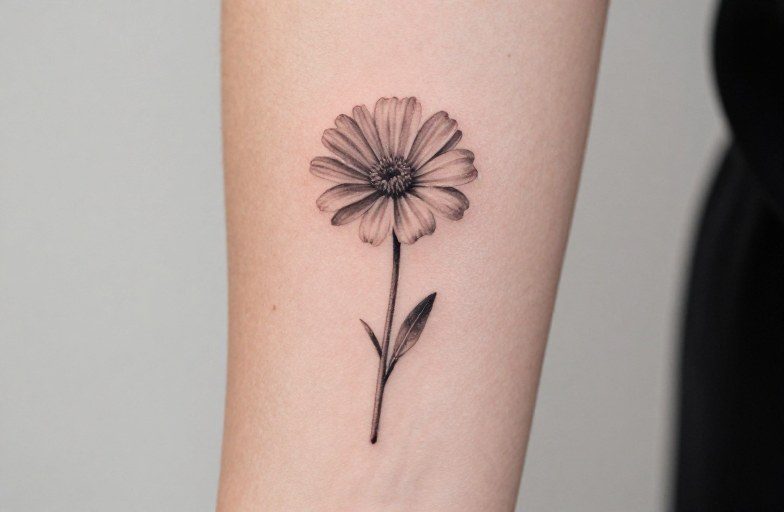
Contemporary artists working in neo-traditional or bold-will-hold styles stretch the formula without breaking it. You might see softer color transitions, additional ornamental elements like moths or hourglasses, or slightly more naturalistic petal structures. Some artists incorporate Japanese influence, background wind bars, or waves, creating a hybrid that respects both traditions. Others pare down to single-needle outline versions that read more delicate but sacrifice the graphic punch of the original.
- Snake through rose: temptation, danger intertwined with beauty
- Dagger piercing rose: sacrificed love, protection through pain
- Banner with name or date: explicit memorial function
- Burning rose: passion, destruction, transformation
Symbolism and History
Roses carry weight across cultures, though Sailor Jerry’s specific visual language filtered these through a particular American lens.
Greek and Roman Threads
The rose is often linked to Aphrodite and Venus, goddesses of love, with the myth of Adonis’s blood sometimes cited as the origin of the red bloom. In Roman contexts, roses appeared at feasts and funerals alike, emblems of fleeting pleasure and eternal memory. Sailor Jerry’s sailors would have absorbed this through popular culture rather than classical education, but the dual association with love and death resonated with men facing Pacific warfare and long separations.
Christian and Memorial Traditions
The rosary, named for the rose garland, connects the flower to prayer and remembrance. In 19th-century American and European mourning culture, dried roses preserved in lockets or pressed into Bibles accompanied grief. Tattooed roses with names or dates translated this domestic practice into permanent, portable form. The thorn specifically evokes the crown of thorns in Christian iconography, adding suffering to beauty without requiring explicit religious commitment from the wearer.
How It Ages on Skin
American traditional rose tattoos age better than most styles because they were designed for aging. Sailor Jerry understood his medium: skin changes, ink spreads, sun damages.
The bold black outline acts as a containment wall. When red pigment inevitably fades toward orange or pink, and green shifts toward blue-gray, that black boundary keeps the shape readable as a rose rather than a blob. Whip-shading, those soft gradients at petal edges, fades to flat color, which actually improves the graphic quality over time. Fine detail, individual stamens, subtle color gradations, disappears within three to five years.
Red pigments historically faded fastest, though modern formulations last longer. The specific Sailor Jerry palette of vermillion and crimson tends to hold reasonably well but will warm toward coral. Greens using older copper-based formulations sometimes shifted toward muddy brown; contemporary artists often select more stable alternatives.
After ten to fifteen years, a well-executed Sailor Jerry rose becomes a softer, slightly blurred version of itself, still unmistakably a rose, still carrying its meaning, but wearing its history visibly. This is the intended lifecycle, not a failure. Touch-ups can refresh color, but many collectors prefer the lived-in quality.
Related Symbols and Context
Understanding what sits adjacent to the Sailor Jerry rose clarifies its specific territory.
Other Sailor Jerry Florals
Swallows, anchors, and ships dominated his nautical work, but flowers appeared strategically. Hibiscus marked Hawaiian service and tropical leave. Lotus connected to Asian port visits. The rose alone carried explicit romantic or memorial intent; other florals signaled place and experience rather than attachment to specific people.
Traditional Tattoo Roses Globally
English roses from the early 1900s often featured more naturalistic shading and softer outlines, sometimes with Victorian ornamental framing. Japanese irezumi roses appear in larger compositions, typically more botanically accurate, with complex background work and color gradations impossible in the American traditional palette. Russian criminal tattoos adopted roses with specific coded meanings: number of petals indicating sentences served, colors signaling rank or affiliation, entirely separate from the Sailor Jerry lineage.
- Heart with dagger: similar love and pain duality, more explicit violence
- Mom banner: parallel memorial and attachment function, different emotional register
- Pin-up girl: contemporary romantic ideal, less permanent than named rose
The Honolulu Context
The Sailor Jerry rose emerged from a specific convergence: military mobilization, Hawaiian tattoo tourism, and the codification of American traditional style.
Smith Street and the Pacific War
Norman Collins established his shop on Smith Street in Honolulu during the 1940s, serving sailors and soldiers passing through Pearl Harbor and en route to Pacific combat. Hawaii’s status as a port of call meant men with money, limited time, and heightened awareness of mortality. Collins refined techniques for speed and clarity: bold lines, limited colors, designs that could be executed in single sessions and read at distance. The rose, already popular in mainland tattooing, became a staple he iterated and improved.
Lasting Influence
Collins died in 1973, but his flash sheets and business practices shaped subsequent generations. Ed Hardy and Mike Malone, who apprenticed under or were deeply influenced by him, carried the visual vocabulary forward. The revival of American traditional tattooing from the 1990s onward drew directly on this archive, with contemporary artists still studying his line weight, color choices, and compositional logic.
The rose remains one of the most requested designs in traditional tattooing precisely because it balances accessibility with depth. A sailor in 1943 and a civilian in 2024 can wear the same image with equally valid but personally distinct meanings. That flexibility, built into the design from its earliest iterations, is perhaps Collins’s most enduring contribution.
Before You Decide
A Sailor Jerry rose is not a subtle choice. It reads clearly from across rooms, carries explicit emotional weight, and ages in ways that reward patience rather than panic. If you are drawn to this design, consider what you want it to say and to whom.
Placement determines visibility and social interpretation. A hand or neck rose signals commitment to outsider identity; a thigh or upper arm piece offers more control over when and how it is seen. Color choices within the traditional palette affect longevity: deeper reds and stable greens hold better than experimental hues. The accompanying elements, banner, dagger, snake, date, name, transform the core meaning significantly.
Choose an artist who understands the tradition, not merely the aesthetic. The difference between a Sailor Jerry rose and a generic traditional rose lies in specific line weight, color mixing, and compositional balance that trained eyes recognize immediately. Ask to see healed work, not just fresh photographs. The true test of this style is how it looks at five years, not five minutes.
The meaning you assign matters more than any historical symbolism. Love, loss, rebellion, or some combination, the rose has held all of these. What it holds for you is the question worth answering before the needle touches skin.
Frequently Asked Questions
Did Sailor Jerry invent the rose tattoo?
No. Roses were already common in American tattooing before his career. Collins refined the specific visual formula: bold outlines, limited palette, and compositional clarity that made his version distinctive and widely copied.
Why do Sailor Jerry roses use such limited colors?
The palette of red, green, yellow, and black was practical. These pigments were available and stable in the 1940s-1950s, and the limited range allowed faster execution for sailors with short shore leave. The colors were also chosen to read clearly under various lighting conditions.
Is a Sailor Jerry rose only for sailors or military?
Not at all. While the design originated in naval culture, it has been widely adopted by civilians. The core themes of love, loss, and remembrance translate across any life experience.
How do I find an artist who does authentic Sailor Jerry style?
Look for portfolios showing healed traditional work, not just fresh photos. Ask specifically about their experience with whip-shading, line weight for aging, and the traditional color palette. Artists who study historical flash sheets and understand the technical constraints of the style will produce more authentic results.